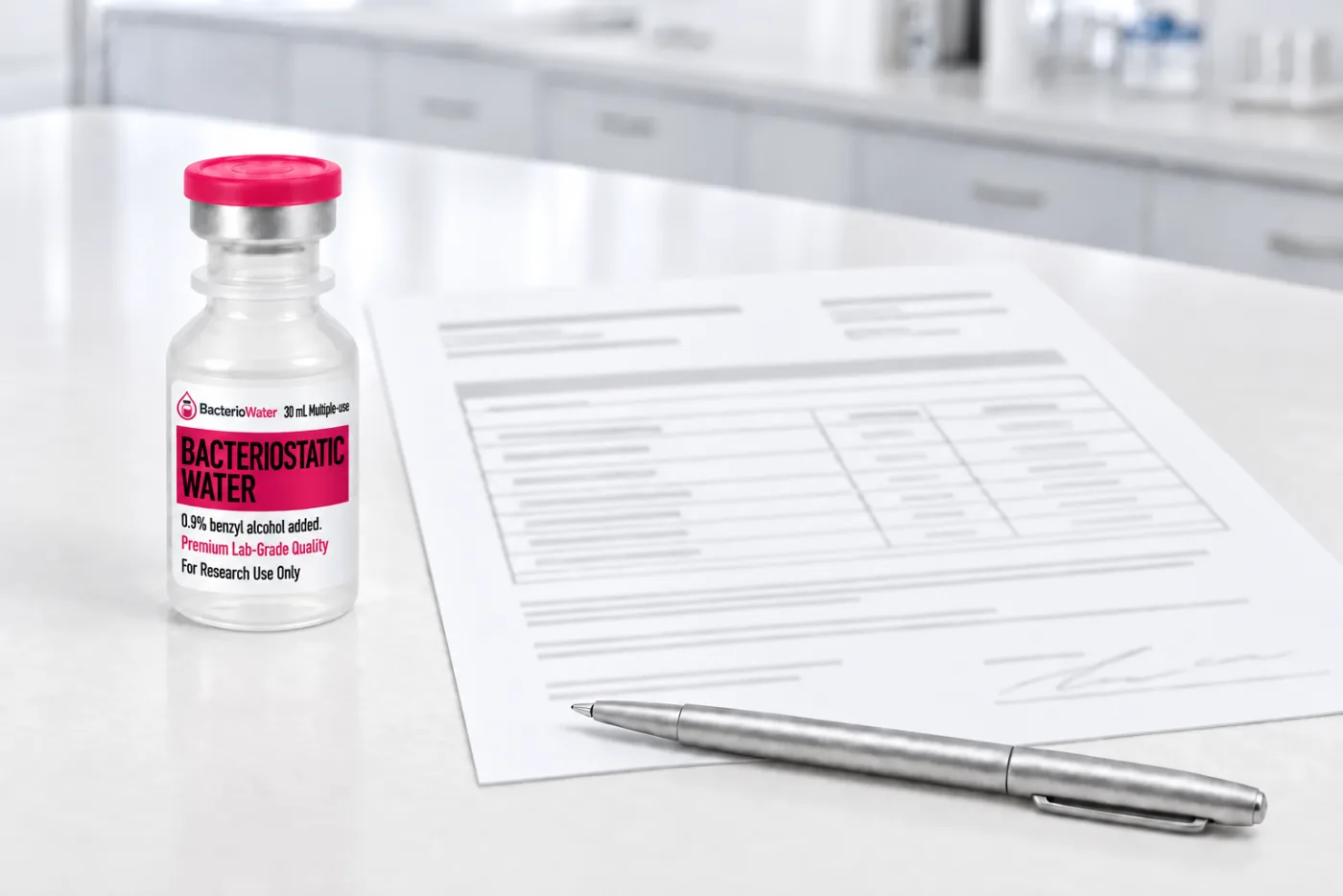
Buying Guides
How to Choose a Bacteriostatic Water Supplier: A Lab Buyer’s Checklist
Every bacteriostatic water listing says the same four things: sterile, lab-tested, premium, fast shipping. None of them can be checked from the listing. What separates a bacteriostatic water supplier you can rely on from one you are taking on faith is whether each of those words resolves to a document you can read, a lot code you can match, or a policy you can hold them to.
This is the checklist a laboratory buyer can run on any supplier before a first order — and again before a repeat one. Each check names what to look for, and each shows how we answer it, including the places where our honest answer is ‘we don’t, and here is who does’.
Published by BacterioWater12 min read
In short
- Judge a supplier by records, not claims: a published per-lot certificate, a lot code on the label that matches it, and a laboratory you can verify with.
- Insist that the certificate reports sterility and endotoxin as results with the method named. Some certificates cover pH and preservative content and stop there.
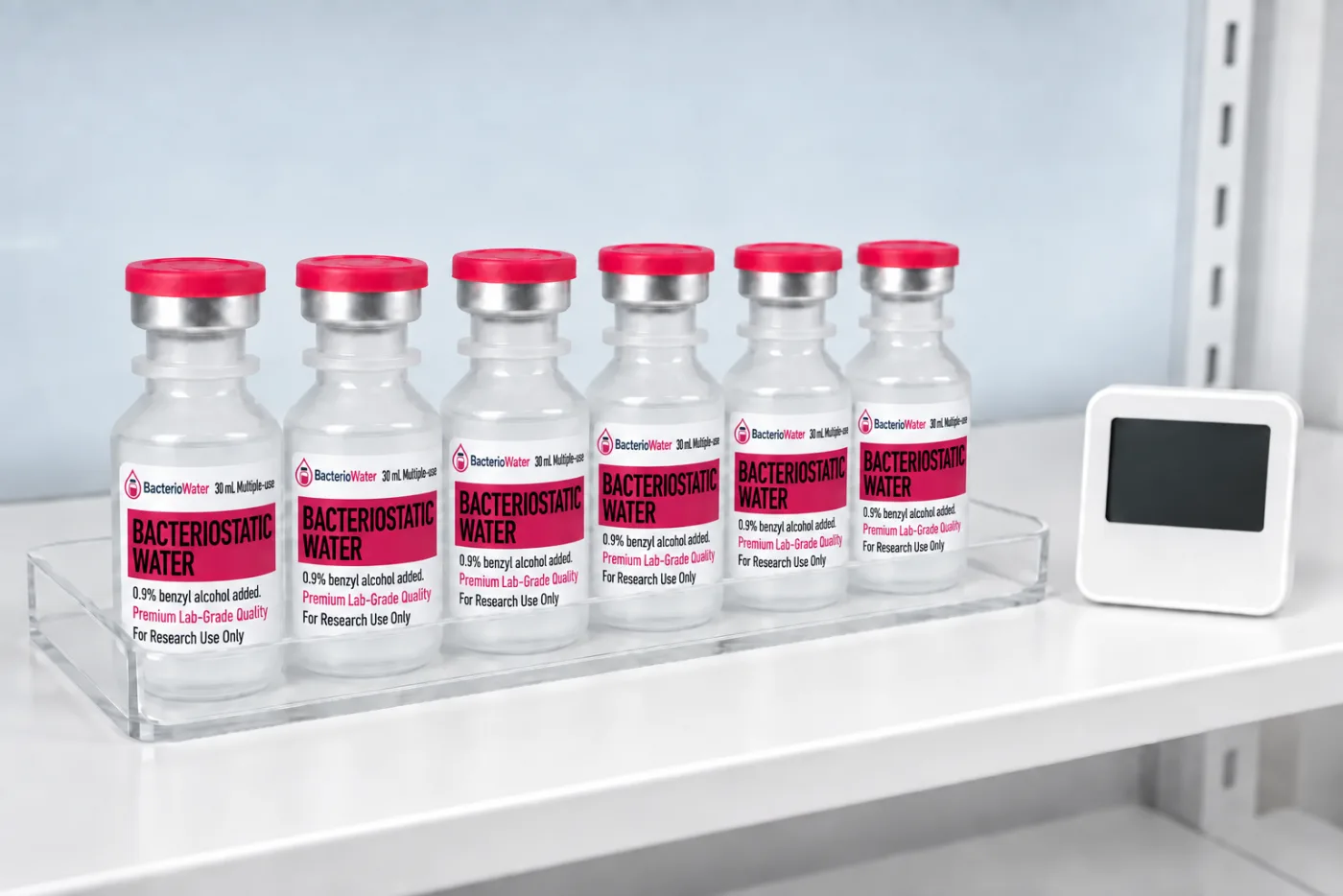
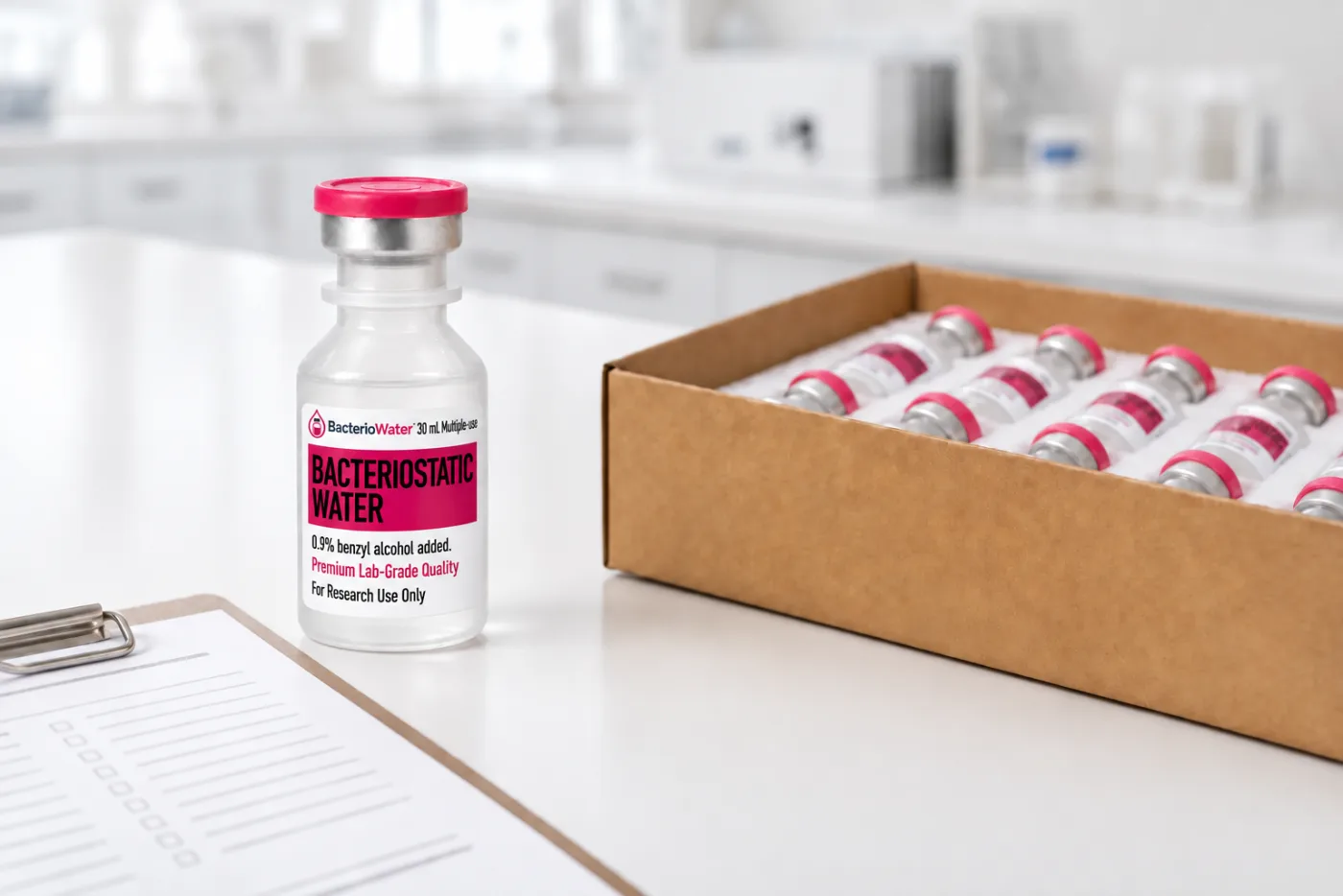
- Get the vial specification in writing: 30 mL multiple-use, 0.9% benzyl alcohol, rubber stopper under an aluminium crimp and flip-off cap, plastic body, lot-coded label.
- A supplier should say plainly whether it manufactures, tests, or resells. What matters is that the chain is documented, not which link you are buying from.
- Fulfilment is a commitment only when it has a cutoff, a carrier, tracking and a written policy for damage. Ours is 2 PM ET, Monday to Friday, UPS, tracked, US only.
Claims are cheap. Records are not.
‘Sterile’, ‘lab-tested’ and ‘lab grade’ cost nothing to type. A record costs something: a lot has to be sampled, a laboratory paid, a certificate issued and published where a buyer can find it. That asymmetry is the whole of supplier evaluation — ask for the record behind each claim and watch how quickly the answers separate.
The eight checks below run from most to least telling. Most can be done from a supplier’s website in minutes; the rest take one email. We answer each for the 30 mL vial we stock, and where the answer is somebody else’s work rather than ours, we say so.
1. A certificate you can match to the vial in the box
The largest single test of a bacteriostatic water supplier is the certificate of analysis — not whether ‘COA’ appears on the site, but whether the document is published, describes one lot, and can be matched to the code on the vial you will receive. ‘Available on request’ means after you have paid. A ‘lab tested’ badge with no document behind it means nothing.
- Published before you order, as the issued document — not a retyped summary.
- Names one lot, and that lot code is printed on the vial label so the two can be matched.
- Issued by a named laboratory that is independent of the seller.
- Carries the laboratory’s certificate number and a route to verify it with them directly.
- Reissued when the lot changes, so the certificate on the site is always for the lot that is shipping.
This is the record for the lot shipping from us now. It is the laboratory’s own certificate, reproduced as issued, and the code on your label should match it:
Current shipping lot
- Product
- 30 mL Sterile Bacteriostatic Water (0.9% benzyl alcohol)
- Tested for
- Sterility · Endotoxins · pH · Benzyl alcohol level
- Laboratory
- Chromate, independent
- Analysed
- May 22, 2026
- Status
- Currently shipping on all orders
The lot code on your vial label should match the code above.
How to read a certificate of analysis walks the document line by line, including how to verify it at the source using the certificate number and access code printed on it.
2. Sterility and endotoxin reported as results, with the method
Not all certificates cover the same tests, and this is where two suppliers who both ‘publish a COA’ can be worth very different amounts. Some certificates report pH and preservative content and stop. For a product whose entire purpose is to be sterile and preserved, a certificate with no sterility row and no endotoxin row has not measured the two things that matter most.
| Test | What to insist on | Lot EB61901, as issued |
|---|---|---|
| Sterility | A result with the method named — USP <71>, or an alternative validated under USP <1223>. ‘Sterile filtered’ is a process step, not a result. | Pass · USP <1223> BacT/ALERT |
| Endotoxins | A number in EU/mL against a stated limit, by a USP <85> technique — not a bare ‘pass’. | < 0.25 EU/ml against a < 0.5 EU/ml limit · kinetic chromogenic LAL |
| Preservative | Identified and quantified by a separation method, not restated from the label. | Identified; 0.921% against 0.9% · RP-HPLC with UV detection |
| pH | A measured value inside the stated range, not the range alone. | 6.253, specification 4.5 – 7.0 |
We perform none of this testing and commission none of it. An independent laboratory analyses a sample of each lot before release, and we publish what it reports, in full, on the Lab Testing & COA page.
3. The vial specification, in writing
A specification is the part of a supplier’s promise you can hold them to on delivery: volume, format, preservative and concentration, closure, container material and what the label states. If any is missing from the product page, ask before ordering rather than after. Ours:
- Volume and format
- 30 mL, multiple-use, in one size only. Packs of 1 to 25 change how many vials ship — never the vial.
- Preservative
- 0.9% benzyl alcohol, identified and quantified on each lot’s certificate rather than assumed from the formulation.
- Closure
- A rubber stopper under an aluminium crimp, with a pink flip-off cap. An intact crimp and cap are your evidence that the vial has not been opened since it was sealed.
- Container
- A semi-translucent plastic vial body rather than glass. The case for plastic is practical: fewer breakages in transit, and a lower risk of glass-related particulate.
- Label
- Product name, volume, the preservative statement, ‘For Research Use Only’, the manufacturer’s expiry and the lot code — the field you match to the published certificate.
- Storage
- Controlled room temperature, 20 °C to 25 °C, protected from excessive heat, strong light and freezing — printed on the product. See storage and handling.
The full specification table, with the measured values for the current lot beside each limit, is on the product page.
4. Who makes it, who tests it, and who is selling it to you
Three parties can stand behind a vial, and a supplier should say which one it is. Some sellers are manufacturers, many are resellers, and a few describe themselves as one while operating as the other. What matters is whether the chain from fill to shelf is documented, not which link you are buying from.
- The manufacturer
- Fills, seals and labels the lot, and sets its formulation, specification and expiry date.
- The independent laboratory
- Receives a sample from the finished lot, analyses it against the written specification and issues the certificate. Its name, certificate number and signatory belong on that document.
- The reseller
- Buys finished, sealed stock, holds it, and ships it. A good one does not alter, repackage or relabel what it receives, and publishes the laboratory’s certificate rather than a summary of it.
BacterioWater is an independent laboratory supplier — in the terms above, a reseller. We do not manufacture, fill, or test this product. Each lot is manufactured and filled by a third-party facility and tested by an independent laboratory, whose certificate we publish in full and exactly as issued. We buy sealed stock and resell it unaltered, and we do not speak for the manufacturer or the laboratory. What we do — and what we don’t sets it out as two lists.
5. Consistency from one order to the next
A first order tests the vial; a repeat order tests the supplier. What a reorder buyer needs is for the fiftieth vial to match the first, and that comes down to how narrow the catalogue is and how the lots are controlled. One formulation, one size, one manufacturer, numbered lots: the simplest arrangement is the one that can be checked.
Ask what ‘lot control’ means in practice. For the product we stock: the run is filled and sealed at the manufacturer with its code on every label; a sample goes to the laboratory; nothing is released until the certificate comes back; and the certificate is published before the lot ships. When lots rotate, the published certificate rotates with them — how a lot gets released shows the four steps, with dates, for the current lot.
If the code on your label ever differs from the one published, that should be a question with a defined answer, not a shrug. Ours: send the code with your order reference and we confirm that lot’s status and its certificate. We stock a single product and fulfil every order from the current tested lot — never from odd stock.
6. Packaging that arrives sealed, padded and plain
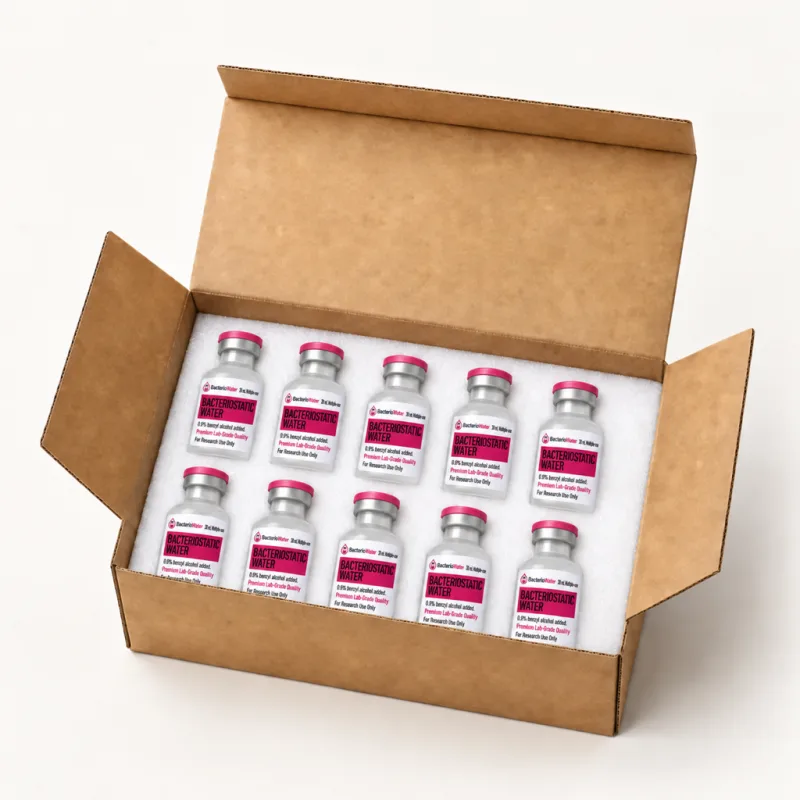
Packaging is the one part of a supplier’s process you inspect with your own hands, so treat the first delivery as an audit. Before anything goes on the shelf:
- Every flip-off cap is present and every crimp is intact — a lifted or missing seal is a reason to set the vial aside.
- No cracks, leaks or deformation of the container; the contents are clear, as the certificate’s appearance line says they should be.
- The lot code on every label matches the certificate published for that lot.
- The outer carton shows no crush or water damage. If anything is wrong, photograph the packaging and the product before discarding either.
From us: plain outer packaging with no product description, vials padded for transit, and larger orders that may arrive in more than one package. Returns ship back to us, and every returned vial is inspected before it is restocked — the seal, the crimp and flip-off cap, the lot code and the condition of the vial. Anything showing signs of mishandling, damage or tampering is not returned to stock. Documented damage, loss or shipment errors are resolved with a replacement or credit. Ask any supplier what happens to vials customers send back: the answer should be a named inspection step, not silence. Shipping & returns has the full policy.
7. US fulfilment you can hold them to
‘Fast shipping’ is not a commitment. A cutoff is. So is a named carrier, a tracking number, and a written procedure for the parcel that stalls or goes missing. These are the questions worth asking a bacteriostatic water supplier before the first order, with our answers beside them:
| Question to ask | Our answer |
|---|---|
| When does an order leave? | Orders placed by 2 PM ET, Monday to Friday, are packed and handed to the carrier the same business day. After the cutoff, at weekends or on a public holiday, the next business day. |
| Where does it ship from? | Okeechobee, Florida. Every order ships within the United States, tracked. |
| Which carriers, and what does it cost? | UPS, with real-time carrier rates calculated at checkout by weight and destination. |
| Will I get tracking? | Yes — tracking details are emailed when the order is dispatched. |
| Do you ship outside the US? | No. US orders only. |
| Where is payment taken? | On a secure Shopify-hosted checkout. Card details go to the payment processor over an encrypted connection and are not stored by us. |
| What if tracking stalls, or shows delivered with nothing received? | Contact us with the order number and tracking details; we follow up with the carrier and open an investigation where needed. The procedure is written into the shipping policy. |
8. Pricing you can read per vial, with a route for volume
Price per vial should be visible on every pack, fall with volume, and not hide behind a quote form. Our shop lists five pack sizes, from a single vial to 25, with the per-vial price and saving printed on each. Orders of 200 vials or more go through a wholesale flow with volume pricing confirmed per order — and ship from the same current tested lot, with the same published certificate, as a single vial does. Contact us to start one.
The checklist
Eight checks, each with the page on this site where it can be confirmed. If a supplier’s site leaves any of them open, one email closes them — send the same list and count how many answers come back as documents.
- A per-lot certificate, published before you order and matchable to the lot code on the label — Lab Testing & COA.
- Sterility and endotoxin reported as results with the method named, alongside preservative identity, quantity and pH — current lot results.
- The vial specification in writing: volume, format, preservative, closure, container and label — product page.
- A plain statement of who manufactures, who tests, and who is selling — our role.
- One formulation, controlled lots, and a defined answer when a label code differs from the published one — how a lot is released.
- Sealed, padded, protective packaging and a written policy for damage — shipping & returns.
- A dispatch cutoff, named carriers, tracking and US-only shipping stated up front — shipping & returns.
- Per-vial pricing on every pack and a wholesale route for 200+ vials — shop.
For laboratory research use only. Not for human or veterinary use. Nothing in this article is a dosing, protocol, or medical instruction. Read the full RUO disclaimer.
References
USP <71> Sterility Tests
The compendial sterility test; alternative methods are validated against it.
USP <1223> Validation of Alternative Microbiological Procedures
How automated growth-detection systems such as BacT/ALERT are validated against the compendial test.
USP <85> Bacterial Endotoxins Test
Gel-clot, turbidimetric and chromogenic techniques, and how results are expressed in EU/mL.
Certificate of Analysis #35348, lot EB61901 — Chromate
Every product result quoted in this guide comes from this certificate, published in full.
Product specification and label
Volume, format, preservative, closure and storage conditions as stated on the product.
Dispatch cutoff, carriers, service area and the replacement procedure quoted above.
Questions this raises
Is buying from a reseller a problem?
Not when it is disclosed. A reseller who buys sealed stock, leaves it unaltered, and publishes the independent laboratory’s certificate for the lot it ships gives you the same documented chain a manufacturer would. The problem is a seller who will not say which it is — or who presents someone else’s testing as its own.
Should a bacteriostatic water supplier be GMP certified?
GMP applies to the facility that manufactures and fills the product, not to a reseller. If a supplier displays a GMP or ISO badge, ask for the certificate behind it — facility name, certifying body, scope and date. BacterioWater operates no facility and claims no facility certification; what we publish is the laboratory’s per-lot certificate.
What if the lot code on my vial does not match the published certificate?
Lots rotate as production runs, and only the lot currently shipping has its certificate published. Send the code on your label with your order reference and we will confirm that lot’s status and provide its certificate. Do not assume — match the code.