Fundamentals
Bacteriostatic Water vs Bacteriostatic Sodium Chloride
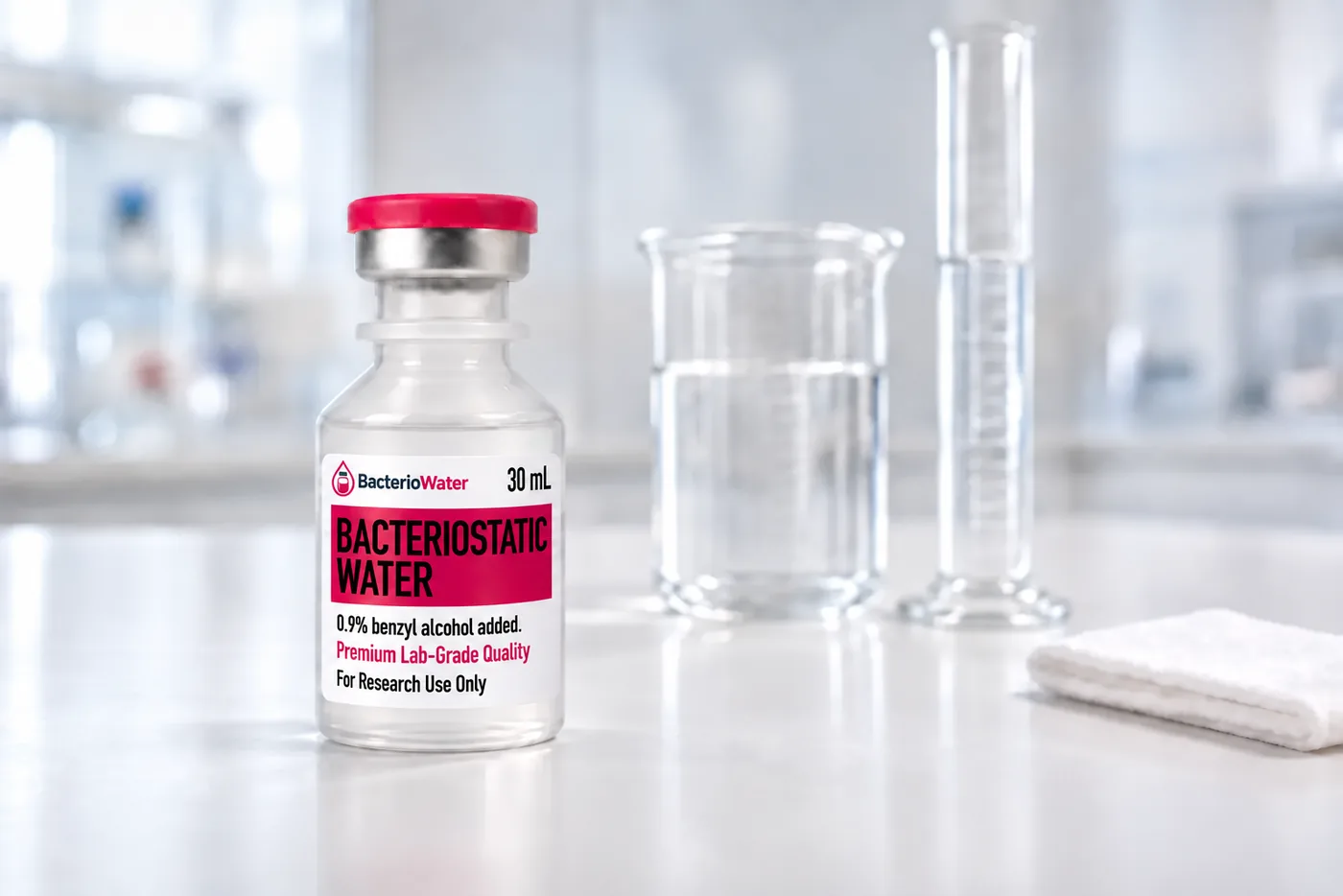
Bacteriostatic water and bacteriostatic sodium chloride are easy to confuse. Both are sterile, both come in stoppered vials, and both carry the same preservative: benzyl alcohol at 0.9%. The difference is one ingredient. Bacteriostatic sodium chloride also contains 0.9% sodium chloride, which makes it a saline solution. Bacteriostatic water, often shortened to bac water, contains no salt.
This guide sets out what each one contains, what the salt changes in laboratory work, and how to tell from the label and the certificate which one is in the vial. It compares two reagents. It is not guidance on using either of them.
Published by BacterioWater5 min read
For laboratory research use only. Not for human or veterinary use. RUO disclaimer
In short
- Both are sterile water with benzyl alcohol added at 0.9% as a preservative. Bacteriostatic sodium chloride also contains 0.9% sodium chloride.
- Bac water is not saline. ‘Bacteriostatic saline’ is another name for bacteriostatic sodium chloride.
- The salt makes bacteriostatic sodium chloride isotonic. Bacteriostatic water is hypotonic, and no isotonic version of it exists.
- Sodium chloride raises ionic strength, which matters for solubility, for LC–MS and other salt-sensitive methods, and for any assay that measures sodium, chloride or conductivity.
- The preservative is the same in both, so neither is the answer when benzyl alcohol itself interferes with the work.
- Check the product name on the label and the certificate for the lot. ‘0.9%’ on its own does not say which substance it refers to.
What each one contains
Both products start from sterile water with benzyl alcohol added at 0.9%, which is 9 mg per mL, as a bacteriostatic preservative. The preservative suppresses the growth of organisms introduced when the stopper is punctured. That is what allows one vial to be entered more than once. Bacteriostatic sodium chloride also dissolves 9 mg of sodium chloride in every mL, the same concentration as normal saline.
| Property | Bacteriostatic water | Bacteriostatic sodium chloride |
|---|---|---|
| Base | Sterile water | Sterile water |
| Preservative | Benzyl alcohol, 0.9% (9 mg/mL) | Benzyl alcohol, 0.9% (9 mg/mL) |
| Sodium chloride | None | 0.9% (9 mg/mL) |
| Tonicity | Hypotonic | Isotonic |
| pH on the drug-product label | 5.7 (4.5 to 7.0) | 5.0 (4.5 to 7.0) |
| Storage on the drug-product label | 20 to 25 °C | 20 to 25 °C |
| Repeat access | Yes, with aseptic technique | Yes, with aseptic technique |
Two 0.9% figures cause most of the confusion. In bacteriostatic water, 0.9% is the benzyl alcohol. In bacteriostatic sodium chloride, the benzyl alcohol is 0.9% and the sodium chloride is also 0.9%. Normal saline is 0.9% sodium chloride with no preservative. A label that says ‘0.9%’ without naming the substance does not tell these three apart.
Is bac water saline?
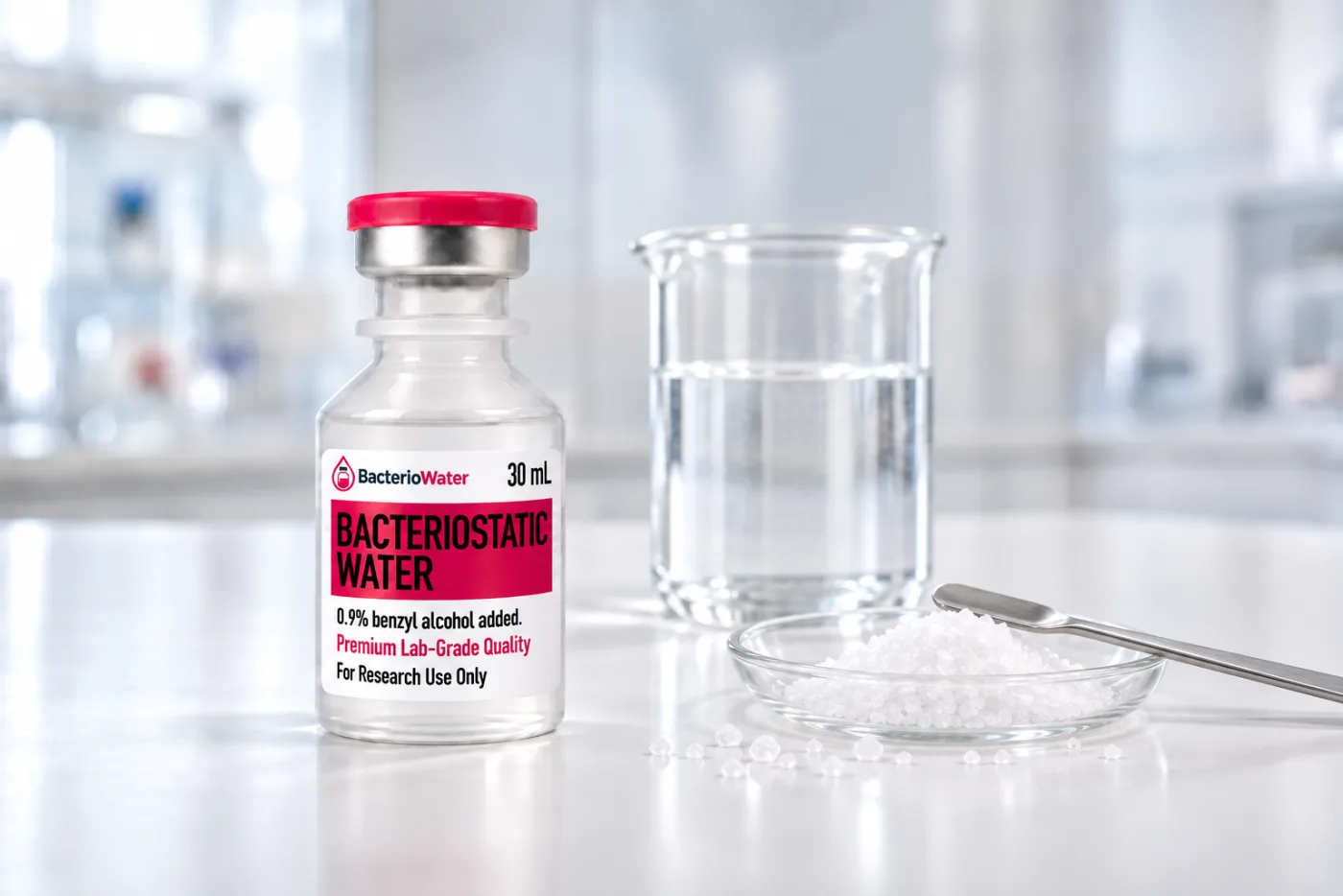
No. Saline is a solution of sodium chloride in water. Bac water contains no sodium chloride, so it is not saline of any kind. ‘Bacteriostatic saline’ is the common name for bacteriostatic sodium chloride: the salt solution with the same preservative added.
There is also no isotonic bacteriostatic water. Tonicity depends on how many dissolved particles a solution carries. Nine grams of sodium chloride per litre is about 154 millimoles, and each unit separates into two ions in water. Nine grams of benzyl alcohol per litre is about 83 millimoles of a molecule that does not separate. The salt solution is isotonic for that reason, and water preserved with benzyl alcohol alone is hypotonic. An isotonic preserved diluent is bacteriostatic sodium chloride.
What the salt changes in lab work
Solubility
Ionic strength changes how materials dissolve. Some compounds dissolve more readily in a salt solution and others less, and proteins can precipitate as salt concentration rises, an effect known as salting out. Neither vehicle is better in general. The documentation for the material being dissolved is what decides.
Salt-sensitive methods
Sodium chloride is a non-volatile salt. In LC–MS it suppresses ionisation, forms sodium adducts and builds up in the source. In any method that measures sodium, chloride or conductivity, it adds a background that bac water does not.
Tonicity
Where osmolality is part of the experimental design, as it is in cell-based work, the two are not interchangeable. The salt solution is isotonic and the preserved water is hypotonic.
The preservative is the same in both
Benzyl alcohol is present at 0.9% in both products, so anything sensitive to it is affected equally by either one. In a UV-detected HPLC run, for example, it appears as a peak; on lot EB61901 it eluted at 4.358 minutes. When the preservative is the problem, the alternatives are the unpreserved forms, sterile water and normal saline. Bacteriostatic water vs sterile water covers that choice.
How to tell which one is in the vial
Start with the product name on the label. ‘Bacteriostatic Water’ and ‘Bacteriostatic 0.9% Sodium Chloride’ are different products, and a label should name the preservative and its concentration. A label that says only ‘bacteriostatic’, or only ‘0.9%’, has not told you which one you have.
Then read the certificate for the lot. A certificate for bacteriostatic water should identify and quantify the benzyl alcohol and report pH, sterility and endotoxin. A certificate for a sodium chloride product should also report the sodium chloride content. Our bac water contains no sodium chloride. The certificate for lot EB61901 reports benzyl alcohol at 0.921% against a 0.9% specification, and pH 5.4.
Current shipping lot
- Product
- 30 mL Sterile Bacteriostatic Water (0.9% benzyl alcohol)
- Tested for
- Identity · Purity · Benzyl alcohol level · Microbial DNA · Sterility · Endotoxins · pH
- Tested by
- Freedom Diagnostics and Chromate, independent
- Reported
- September 4, 2026
- Status
- Currently shipping on all orders
The lot code on your vial label should match the code above.
How to read a certificate of analysis explains each line of the document. The certificates for the lot shipping now are published in full on our Lab Testing & COA page.
Ordering bac water
We supply one product: bacteriostatic water in a 30 mL vial, preserved with 0.9% benzyl alcohol, with the certificates for each lot published. The price per vial falls as the pack size goes up.
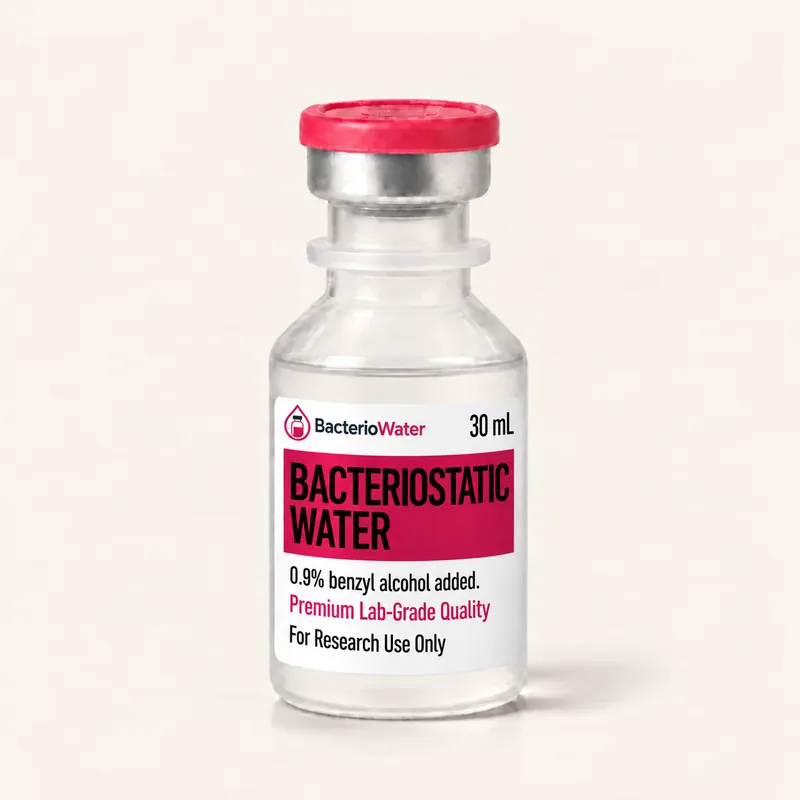
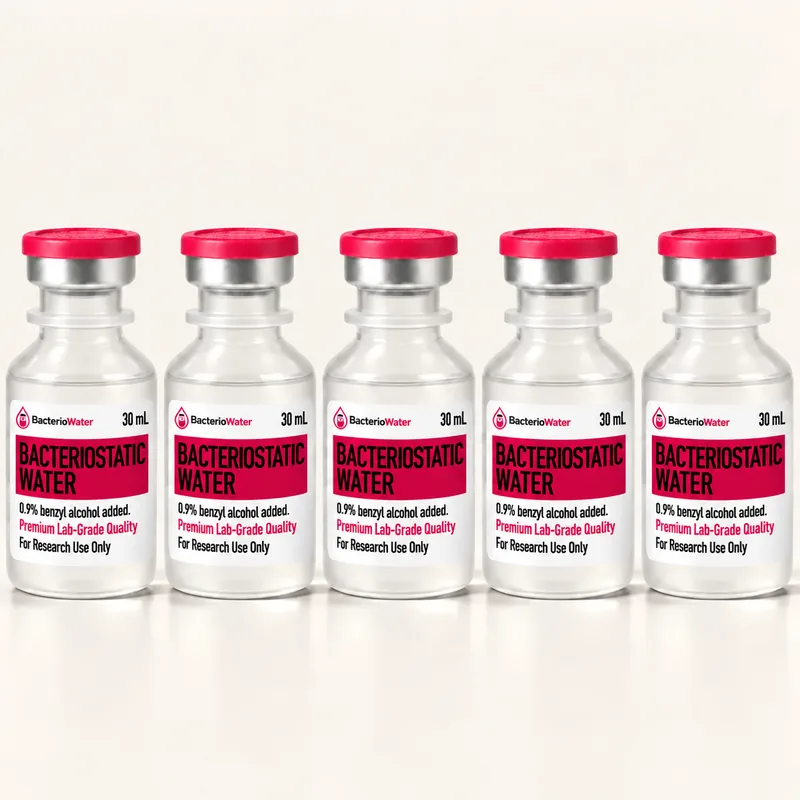
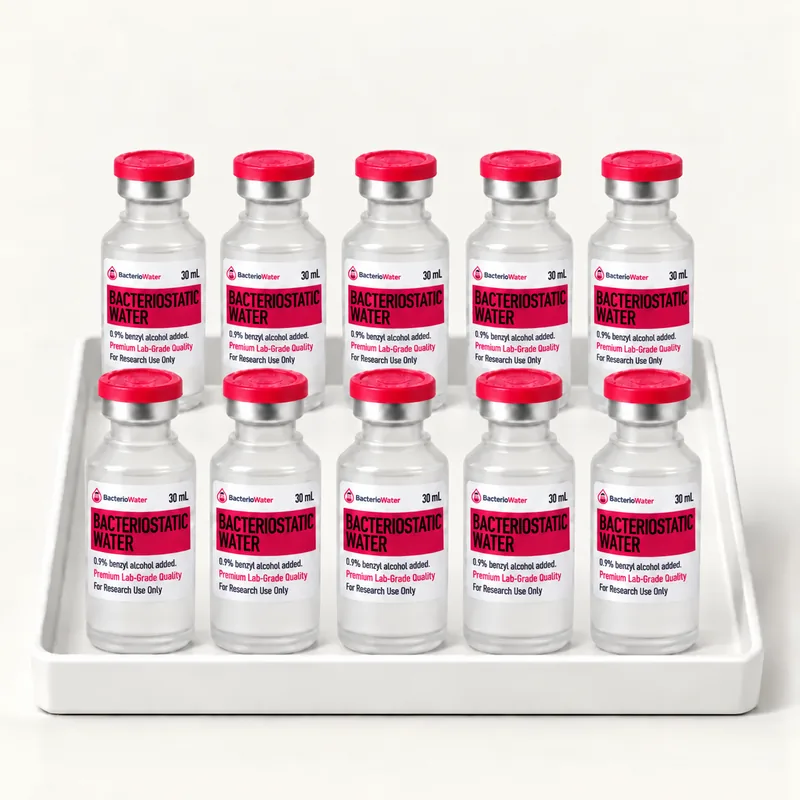
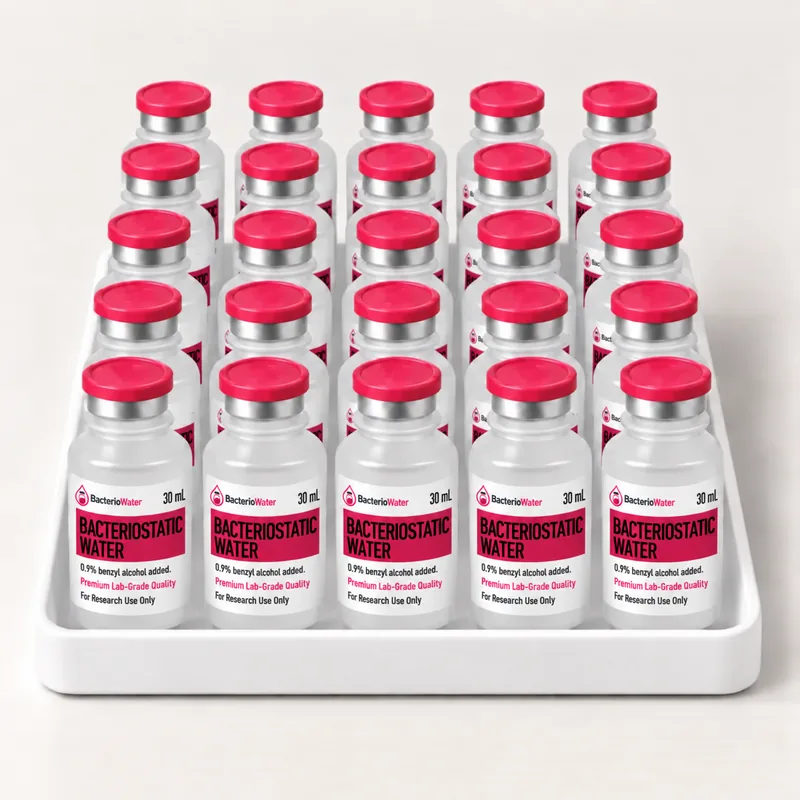
Every pack contains the same 30 mL bac water vial. All pack sizes, from 1 to 200 vials, are in the shop, and orders of 300 vials or more are quoted through wholesale.
For laboratory research use only. Not for human or veterinary use. Nothing in this article is a dosing, protocol, or medical instruction. Read the full RUO disclaimer.
References
DailyMed — Bacteriostatic Sodium Chloride, Hospira (label revised 02/2019)
Composition of 9 mg sodium chloride and 9 mg benzyl alcohol per mL, ‘isotonic’, pH 5.0 (4.5 to 7.0), and storage at 20 to 25 °C.
DailyMed — Bacteriostatic Water, Hospira (label revised 08/2019)
Benzyl alcohol as the only added substance, pH 5.7 (4.5 to 7.0), and storage at 20 to 25 °C.
PubChem CID 244 — benzyl alcohol
Molar mass 108.14 g·mol⁻¹, used for the 83 millimoles per litre figure.
PubChem CID 5234 — sodium chloride
Molar mass 58.44 g·mol⁻¹, used for the 154 millimoles per litre figure.
Certificates of analysis, lot EB61901
Benzyl alcohol content, pH and the HPLC retention time quoted above.
Questions this raises
Is bacteriostatic sodium chloride the same as normal saline?
No. Normal saline is 0.9% sodium chloride in water with no preservative. Bacteriostatic sodium chloride is the same salt solution with 0.9% benzyl alcohol added, so the vial can be entered more than once.
Is there an isotonic bacteriostatic water?
No. Water preserved with benzyl alcohol alone is hypotonic. The isotonic preserved option is bacteriostatic sodium chloride, which adds 0.9% sodium chloride.
Does BacterioWater sell bacteriostatic sodium chloride?
No. We supply bacteriostatic water in 30 mL vials, with the certificates for each lot published. We do not stock bacteriostatic sodium chloride.