Fundamentals
Bacteriostatic Water vs Sterile Water vs Water for Injection
Four clear liquids sit on most reagent shelves — bacteriostatic water (bac water), sterile water, water for injection and 0.9% sodium chloride. On the bench they look identical. The difference is entirely in what was added, what the container is rated for, and what the label is allowed to say.
This is a reference for laboratory buyers: what each grade is, what the compendial names mean, and how to confirm from the label and the certificate which one is actually in the vial in front of you.
Published by BacterioWater6 min read
For laboratory research use only. Not for human or veterinary use. RUO disclaimer
In short
- Bacteriostatic water is sterile water with an antimicrobial preservative added — in practice, 0.9% benzyl alcohol.
- The preservative is what makes repeated access to one container possible: it suppresses bacterial growth between accesses. It does not sterilise anything.
- Sterile water contains no preservative and is packaged for a single entry.
- Water for injection is the compendial bulk water the packaged grades are made from; purified water is a lower grade with no endotoxin requirement.
- Saline is not a water grade at all — it is 0.9% sodium chloride, and the shared 0.9% figure refers to a completely different substance.
The short answer
Bacteriostatic water is sterile water that has an antimicrobial preservative added so the container can be entered more than once. Sterile water has no preservative and is packaged for a single entry. Nearly every practical difference between the two — container format, in-use dating, assay compatibility — follows from that one change.
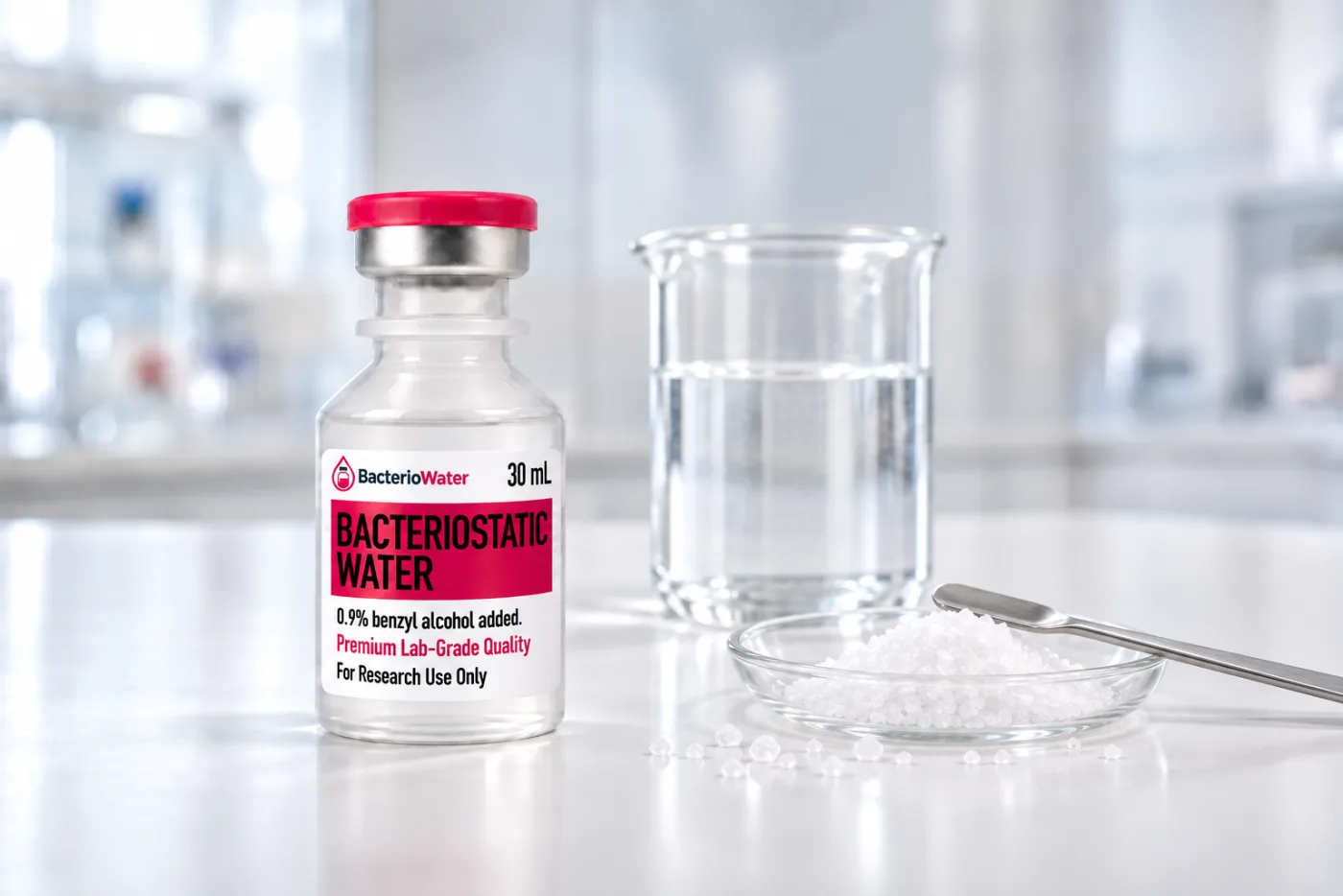
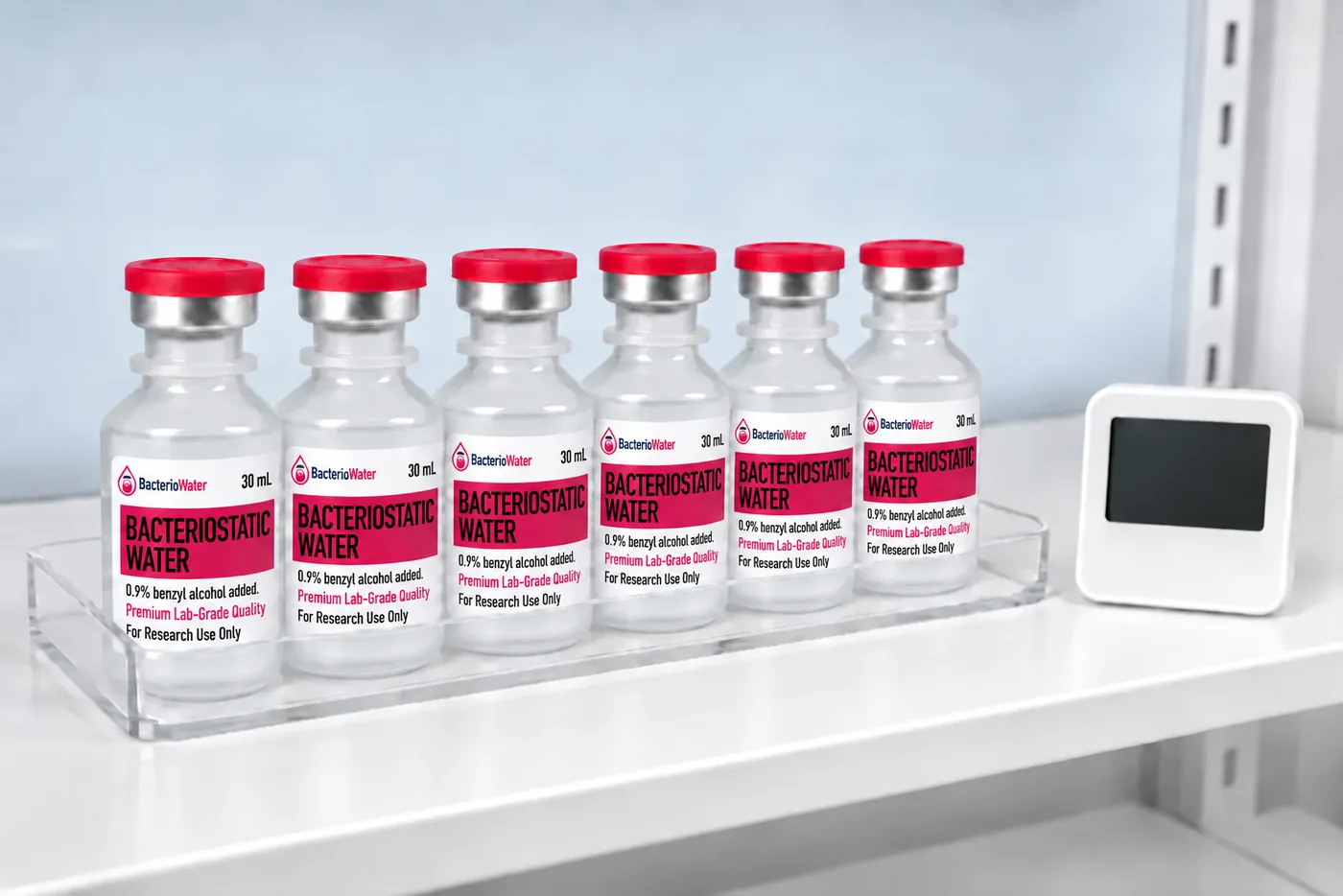
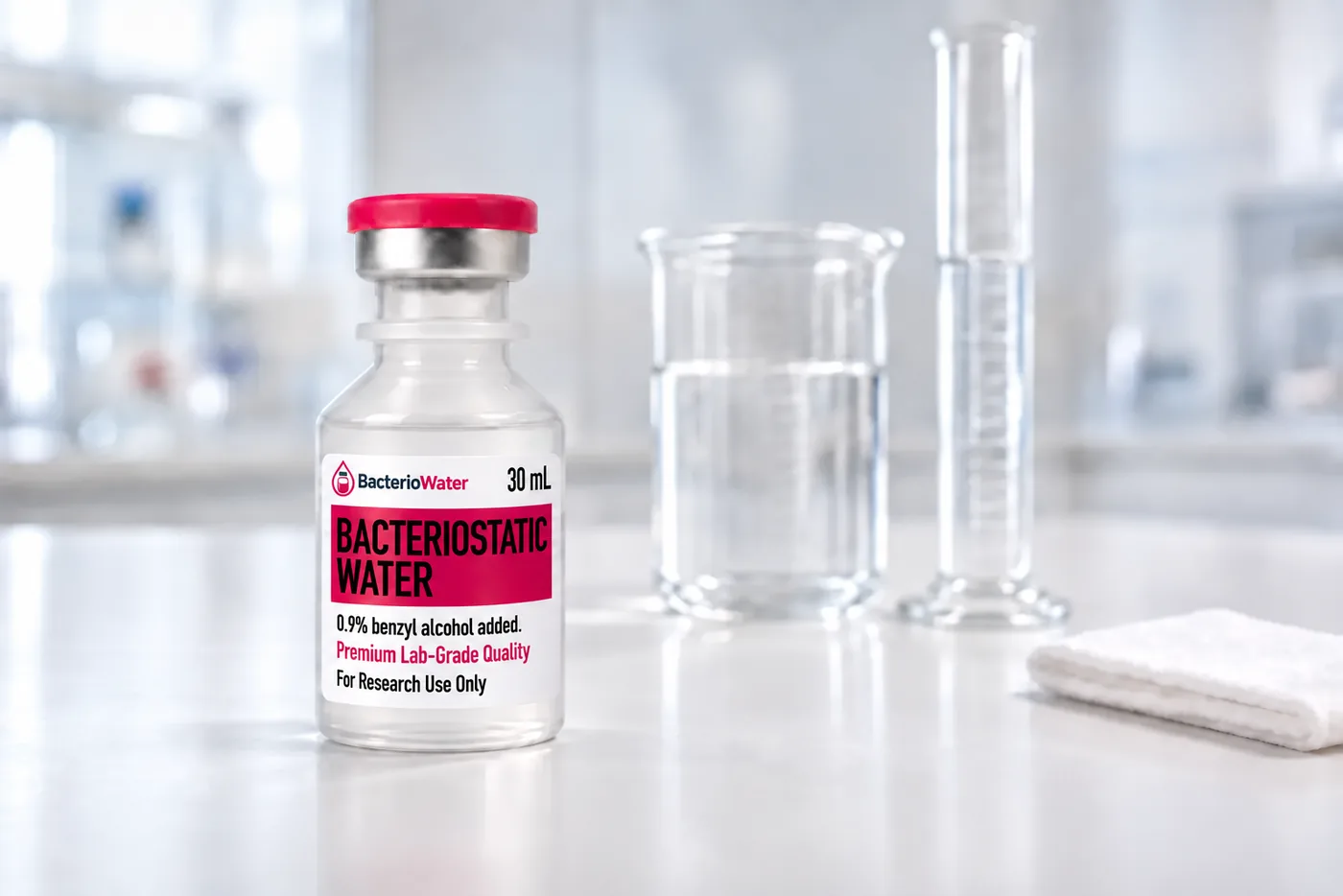
The preservative in essentially every bacteriostatic water on the market is benzyl alcohol at 0.9% w/v. That is the long-standing compendial concentration, and it is what is in the 30 mL vial we supply — identified and quantified on the certificate for every lot.
What ‘bacteriostatic’ actually means
Bacteriostatic means growth-inhibiting. Bactericidal means killing. Benzyl alcohol at 0.9% is the former: it suppresses the proliferation of organisms introduced during access. It does not sterilise the contents, and it cannot undo a contamination event that has already happened.
That distinction sets how the vial should be treated. A preserved vial is still handled aseptically — the preservative is a margin against small incidental challenges, not a substitute for technique. The practical side of that is covered in storage and handling.
Benzyl alcohol (CAS 100-51-6, C₇H₈O, 108.14 g·mol⁻¹) is also an ordinary organic solvent, and it is UV-active. Both facts matter downstream, and both are the reason unpreserved water exists as a separate product rather than as a cheaper version of the same thing.
The grades side by side
| Grade | Preservative | Sterile as packaged | Built for repeat access | Typical container |
|---|---|---|---|---|
| Bacteriostatic water | Yes — 0.9% benzyl alcohol | Yes | Yes, with aseptic technique | Stoppered vial |
| Sterile water | None | Yes | No — single entry | Single-dose vial or bag |
| Water for injection (bulk) | None | Not as supplied | n/a | Bulk process water |
| Purified water | None | No | n/a | Bulk process water |
| 0.9% sodium chloride | Depends on the form | Yes | Only in preserved forms | Vial or bag, by form |
The separation between the two bulk grades is endotoxin. Water for injection carries a bacterial endotoxin limit of 0.25 USP EU/mL; purified water carries no endotoxin requirement at all. That is the single line that decides which one can sit upstream of an injectable-grade product, and it is why ‘purified water’ is not a substitute anywhere endotoxin is in scope.
Packaged waters state their own endotoxin specification per lot. Ours is < 0.5 EU/mL; lot EB61901 reported < 0.25 EU/mL by kinetic chromogenic LAL. A supplier who cannot tell you that number for the lot in the box has not told you very much.
Bac water vs deionized or distilled water
Deionized and distilled describe how water was purified, not whether it is sterile. Deionization strips dissolved ions on exchange resins; distillation boils the water and condenses the vapour. Either route can be used to make purified water, and neither term, as it usually appears on a label, says anything about sterility, endotoxin or a preservative.
That puts a bottle of deionized or distilled water in a different class of reagent from bac water: no preservative, normally no sterility claim, and no endotoxin limit unless the label states one. Where the work needs sterile, endotoxin-controlled water in a vial that can be entered more than once, neither is a substitute. Where the preservative would interfere with the work, unpreserved water is the right choice and bacteriostatic water is not.
Where the difference shows up in lab work
Repeat access
A preserved vial can be entered repeatedly, so one 30 mL container replaces a row of single-use ampoules and the consumable cost per access falls sharply. What that changes is where the contamination risk sits: with a single-use container it is in the manufacturing; with a container that is entered repeatedly, it moves to your stopper technique.
Solvent effects and assay interference
Benzyl alcohol is an organic solvent that absorbs in the low UV. In an RP-HPLC run with UV detection it is a real peak — on lot EB61901 it elutes at 4.358 minutes. If your method integrates in that region, or your assay is otherwise preservative-sensitive, unpreserved water is the correct reagent and no amount of care with the preserved vial will fix it.
Tonicity: why saline is not a substitute
Saline is isotonic because of the sodium chloride; water of every grade is hypotonic. Where osmolality is a variable in the work, the two are not interchangeable, and the fact that both names contain ‘0.9%’ is a coincidence of formulation, not a similarity. The preserved salt solution is compared in bacteriostatic water vs bacteriostatic sodium chloride.
Storage
Preserved water is a controlled-room-temperature product: 20–25 °C, protected from excessive heat, strong light and freezing. Cold storage is not a way of being extra careful with it — see storage and handling for why freezing is the failure mode that gets missed.
How to confirm what you actually received
Start with the label. It should state the grade, the preservative and its concentration, the volume, the lot code and the expiry. A label that says ‘sterile water’ with no preservative statement is telling you it is unpreserved; a label that names a preservative without a concentration is telling you less than it should.
Then read the certificate for that lot. For a preserved water, a certificate should both identify and quantify the preservative rather than asserting it. On lot EB61901 both were determined by RP-HPLC with UV detection, returning benzyl alcohol at 0.921% against a 0.9% specification, alongside sterility, endotoxins and pH.
How to read a certificate of analysis walks that document line by line. The certificate for the lot shipping right now is published in full on our Lab Testing & COA page, with the lab’s certificate number and access code so it can be checked at the source.
For laboratory research use only. Not for human or veterinary use. Nothing in this article is a dosing, protocol, or medical instruction. Read the full RUO disclaimer.
References
USP <71> Sterility Tests
The compendial sterility test that alternative automated methods are validated against.
USP <85> Bacterial Endotoxins Test
Defines the gel-clot, turbidimetric and chromogenic techniques used to report endotoxin.
DailyMed — bacteriostatic water product labeling
The FDA-approved labeling for drug-product bacteriostatic water, for comparison with reagent-grade labels.
PubChem CID 244 — benzyl alcohol
Identity data for the preservative: CAS 100-51-6, C₇H₈O, 108.14 g·mol⁻¹.
Certificate of Analysis #35348, lot EB61901
Every product figure quoted above comes from this certificate.
Questions this raises
Is bacteriostatic water sterile?
Yes. It is sterilised during manufacture and the finished lot is tested for sterility before release. The benzyl alcohol is a preservative added on top of that to suppress growth between accesses — it is not what makes the water sterile in the first place.
Is bacteriostatic water the same as saline?
No. Saline is 0.9% sodium chloride dissolved in water and is isotonic. Bacteriostatic water contains no salt, is hypotonic, and its 0.9% figure refers to benzyl alcohol — a preservative, not a solute contributing tonicity.
Why is 0.9% the standard benzyl alcohol concentration?
0.9% w/v is the established compendial concentration for benzyl-alcohol-preserved water, and it is what buyers and specifications assume. It should still be measured per lot rather than assumed — lot EB61901 was quantified at 0.921% against a 0.9% specification.