Fundamentals
Pharmaceutical vs Research-Grade Bacteriostatic Water
Bacteriostatic water (bac water) is sold as two different products under one name. One is a prescription drug: Bacteriostatic Water for Injection, USP, made under an FDA-approved application and dispensed by pharmacies. The other is a laboratory reagent with the same basic formulation, sold for research use only. The vials can look alike. The label, the rules and the paperwork are different.
This guide explains what separates the two, why a prescription applies to one and not the other, and how to tell from the label which one you are holding. It is general information, not legal or medical advice.
Published by BacterioWater8 min read
For laboratory research use only. Not for human or veterinary use. RUO disclaimer
In short
- Bacteriostatic Water for Injection, USP is a prescription drug. Its label carries ‘Rx only’, a National Drug Code and an FDA application number.
- When we checked the FDA’s drug listings in October 2026, every bacteriostatic water product listed under an approved application referenced one: Hospira’s NDA 018802.
- Research-grade bacteriostatic water is a laboratory reagent. It is labelled for research use only, not for human or veterinary use, and each lot is documented by a certificate of analysis.
- In law, intended use separates the two. It is shown by the label, the advertising and the circumstances of sale.
- A reagent is not a substitute for the drug product. If a person or an animal needs bacteriostatic water, a clinician prescribes it and a pharmacy dispenses it.
- Read the label. ‘Rx only’ and an NDC mean the drug product. ‘For research use only’ means a reagent.
Two products, one name
Both products are sterile water with benzyl alcohol added at 0.9% as a preservative. The preservative suppresses the growth of organisms introduced when the stopper is punctured, so one vial can be entered more than once. Chemically, that is the whole formulation in both cases.
Everything else differs: who approved it, how it was made and released, what the label allows, and who it is sold to. The table sets the two side by side.
| Bacteriostatic Water for Injection, USP | Research-grade bacteriostatic water | |
|---|---|---|
| Regulatory status | FDA-approved prescription drug | Laboratory reagent, not an approved drug |
| Label statement | ‘Rx only’ and ‘For drug diluent use only’ | ‘For research use only’, usually with ‘not for human or veterinary use’ |
| Identifiers on the label | National Drug Code (NDC) and the USP name | Lot code, matched to the supplier’s certificate of analysis |
| Quality standard | The USP monograph named on the label, made under drug manufacturing rules | The supplier’s specification, tested lot by lot |
| How quality is documented | The approved application and the manufacturer’s release records | A certificate of analysis for each lot, issued by the testing laboratory |
| How it is obtained | Dispensed by a pharmacy against a prescription; supplied to hospitals and clinics through drug distribution channels | Sold to laboratories and researchers by research suppliers |
| Intended use | As set by the approved label | Laboratory research and analysis |
The drug product: Bacteriostatic Water for Injection, USP
Bacteriostatic Water for Injection, USP is a human prescription drug. Its 30 mL vial label carries ‘Rx only’, the NDC 0409-3977-01 and the instruction ‘For drug diluent use only’. It is marketed under a New Drug Application, NDA 018802, held by Hospira, a Pfizer company.
When we checked the FDA’s National Drug Code Directory in October 2026, every bacteriostatic water product listed under an approved application referenced that same NDA. Other company names on those listings are distributors that relabel or repackage the approved product. This is why ‘Hospira bacteriostatic water’ is often used as shorthand for the drug product itself.
As a finished drug, it is made under the FDA’s current good manufacturing practice rules for pharmaceuticals, 21 CFR parts 210 and 211. ‘USP’ in the name means the product meets the United States Pharmacopeia monograph of that name. A pharmacy dispenses it against a prescription. Hospitals and clinics obtain it through drug distribution channels.
The research reagent: research-grade bacteriostatic water
Research-grade bacteriostatic water is sold to laboratories as a reagent, a diluent and solvent for research and analytical work. It has no NDC and no approved application, and it is not represented as a USP drug product. Its label says what it is for: laboratory research use only, not for human or veterinary use.
Without an approved drug label behind it, a reagent’s quality has to be shown another way. The usual way is a certificate of analysis for each lot, issued by the laboratory that tested it. A useful certificate identifies and quantifies the preservative and reports sterility, endotoxin and pH, each with its method.
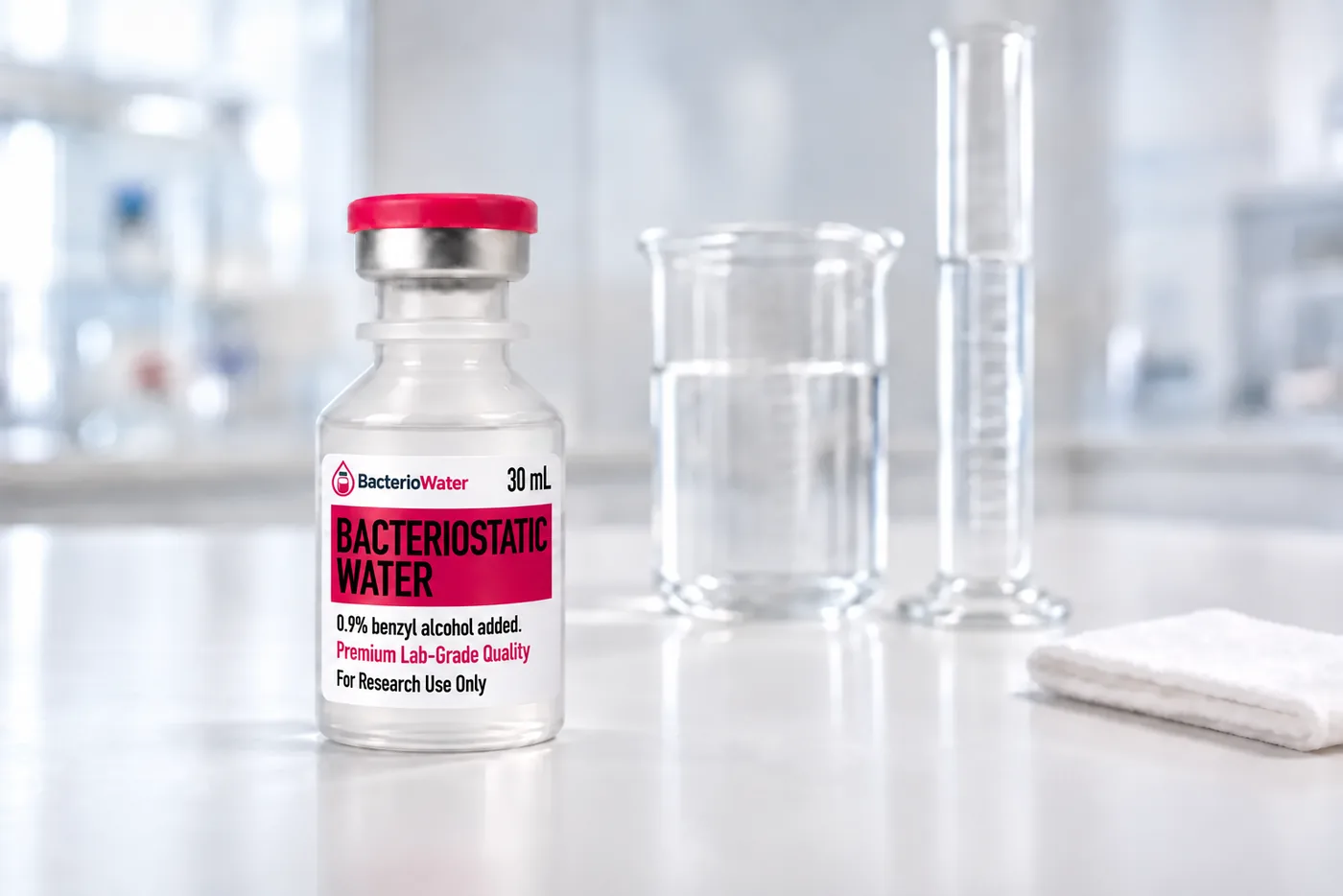
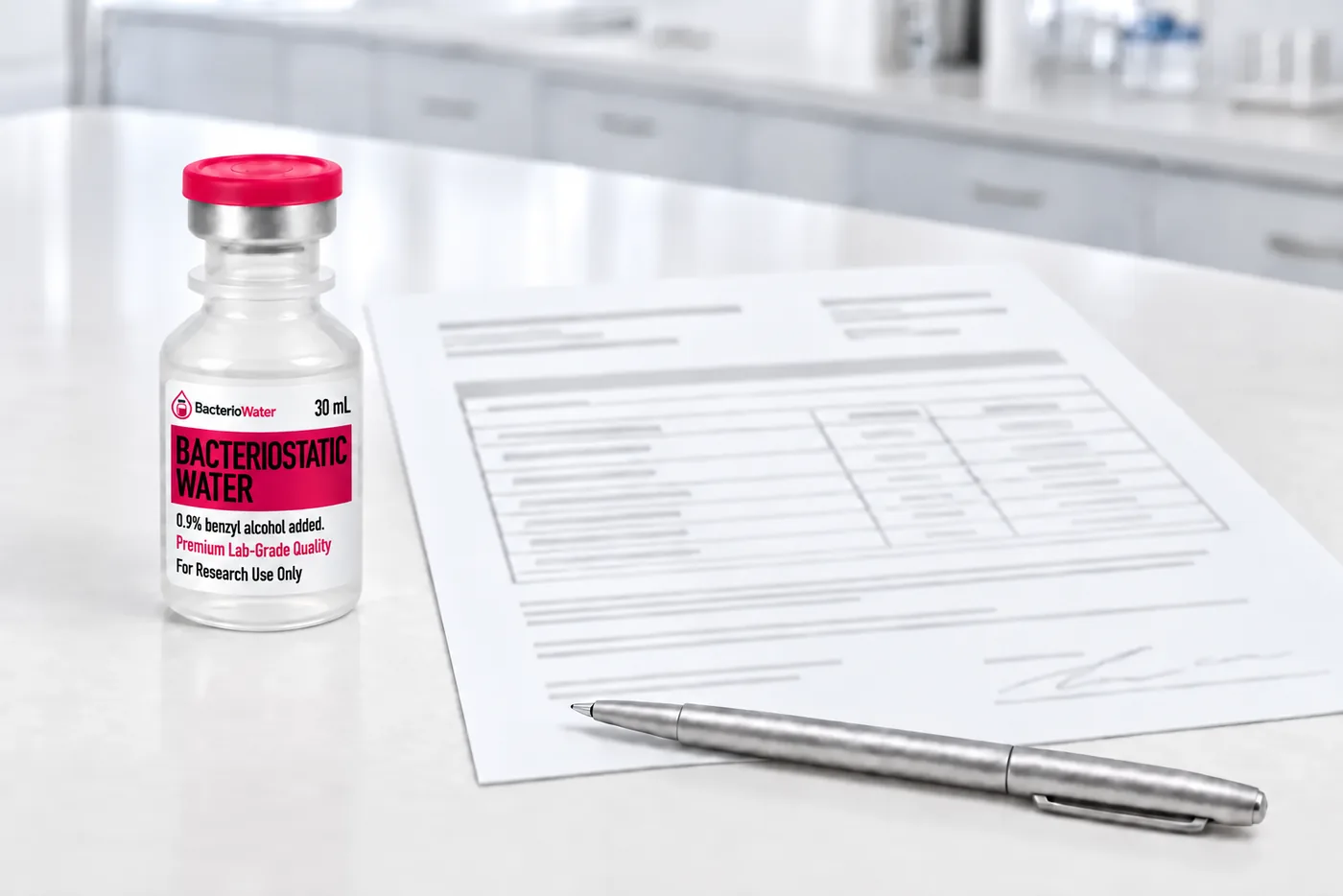
Our 30 mL vial is a reagent of this kind. A third-party manufacturer fills it, an independent laboratory tests each lot, and we publish the certificates. For lot EB61901, the release certificate reports benzyl alcohol at 0.921% against a 0.9% specification, sterility as a pass, endotoxins below 0.25 EU/mL against a specification of below 0.5 EU/mL, and pH within the 4.5 to 7.0 range.
Current shipping lot
- Product
- 30 mL Sterile Bacteriostatic Water (0.9% benzyl alcohol)
- Tested for
- Identity · Purity · Benzyl alcohol level · Microbial DNA · Sterility · Endotoxins · pH
- Tested by
- Freedom Diagnostics and Chromate, independent
- Reported
- September 4, 2026
- Status
- Currently shipping on all orders
The lot code on your vial label should match the code above.
How to read a certificate of analysis explains each line of that document. Every certificate for the lot in stock is on our Lab Testing & COA page, with the code the laboratory verifies it by.
Why intended use decides the category
The Federal Food, Drug, and Cosmetic Act defines a drug largely by what an article is meant for. Section 201(g)(1), codified at 21 U.S.C. 321(g)(1), includes ‘articles intended for use in the diagnosis, cure, mitigation, treatment, or prevention of disease in man or other animals’.
The FDA’s regulation on intended use, 21 CFR 201.128, says how that intent is judged. It is the objective intent of the people responsible for the labelling. It can be shown by labelling claims, advertising, written or oral statements, and the circumstances in which the product is sold.
In practice, a reagent supplier has to keep the label, the advertising and the sale consistent with research use. That is why our pages carry no dosing, protocols or use instructions. It is also why we never describe our product as a substitute for the drug product.
Do you need a prescription, and is bac water illegal?
For the drug product, yes, a prescription is needed. Bacteriostatic Water for Injection, USP is labelled ‘Rx only’, so a pharmacy dispenses it only against a prescription. If a person or an animal needs bacteriostatic water, that is the route: a clinician prescribes it and a pharmacy fills it.
Bacteriostatic water is not a controlled substance, and buying it as a laboratory reagent for research is not illegal. The FDA drug label lists no DEA schedule. A reagent that is labelled, sold and bought for research is a different product, in a different channel, from the prescription drug.
What the rules turn on is intended use and labelling. A reagent that is labelled, promoted or sold for use in people or animals can be treated as a drug, whatever its label says, and an unapproved one. This is general information about how the rules are structured, not legal advice. Questions about a specific situation belong with a lawyer or your institution’s compliance office.
Hospira bacteriostatic water vs research-grade bac water
Hospira’s product is the approved drug. Research-grade bac water is a reagent. Both are sterile water with 0.9% benzyl alcohol, and the difference is everything around the liquid. On one side are the approved application, drug manufacturing rules, the NDC, prescription status and the approved label. On the other are the supplier’s specification, a certificate for each lot and research-use labelling.
Neither is a better version of the other. They are made for different purposes, and the reagent cannot be used in place of the drug product. If what you need is the drug product, the route is a prescription and a pharmacy. If you need a reagent for laboratory work, the route is a research supplier that publishes a certificate for the lot it ships. Where to buy bacteriostatic water compares those channels.
How to tell which one you have
The label settles it. Look for these markings:
- ‘Rx only’ means a prescription drug.
- An NDC, a ten-digit code in three segments such as 0409-3977-01, means a product listed with the FDA as a drug.
- ‘Bacteriostatic Water for Injection, USP’ as the product name means the drug product.
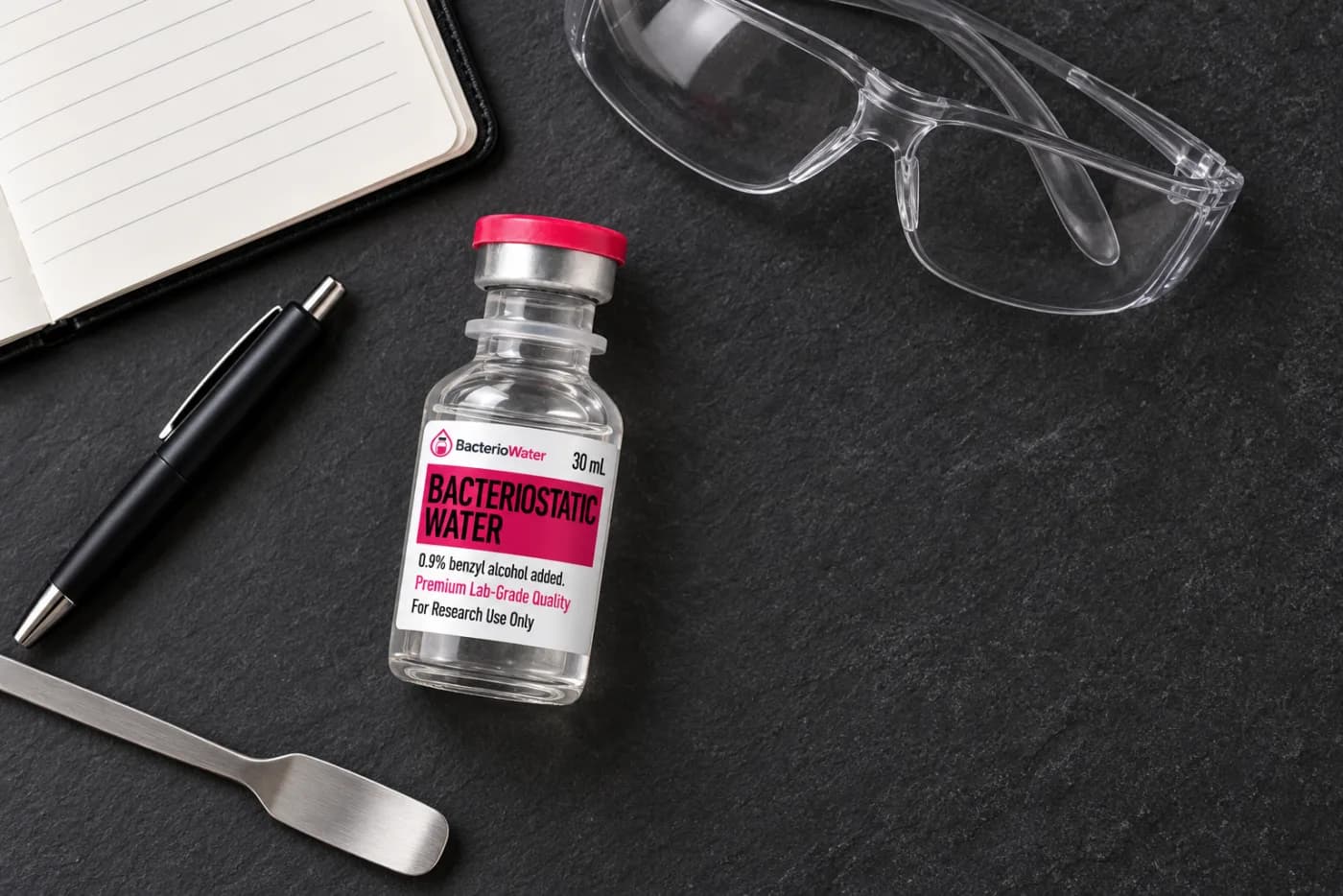
- ‘For research use only’ or ‘Not for human or veterinary use’ means a laboratory reagent.
- A lot code you can match to a published certificate of analysis is how a reagent documents its quality.
For a reagent, the certificate is the part to read closely. It should name the lot on your vial and report each result with its method. Grade differences between bacteriostatic water, sterile water and water for injection are covered in bacteriostatic water vs sterile water.
For laboratory research use only. Not for human or veterinary use. Nothing in this article is a dosing, protocol, or medical instruction. Read the full RUO disclaimer.
References
DailyMed — Bacteriostatic Water, Hospira (label revised 08/2019)
‘Rx only’, NDC 0409-3977-01 for the 30 mL vial, NDA 018802, ‘For drug diluent use only’, 0.9% benzyl alcohol, DEA schedule: none, and a Pfizer facility among the listed manufacturing establishments.
FDA National Drug Code Directory
Checked through openFDA on 20 October 2026: bacteriostatic water listings under an approved application all referenced NDA 018802.
21 U.S.C. 321(g)(1) — FD&C Act section 201(g)(1)
The statutory definition of a drug, quoted above.
21 CFR 201.128 — Meaning of ‘intended uses’
How the FDA judges intended use: labelling claims, advertising, statements and the circumstances of distribution.
21 CFR parts 210 and 211
Current good manufacturing practice for drugs and for finished pharmaceuticals.
Certificates of analysis, lot EB61901
Benzyl alcohol content, sterility, endotoxin and pH for our product, as quoted above.
Questions this raises
Do you need a prescription for bacteriostatic water?
For the drug product, yes. Bacteriostatic Water for Injection, USP is labelled ‘Rx only’ and is dispensed by a pharmacy against a prescription. Research-grade bacteriostatic water is a laboratory reagent sold for research use. It is not for use in people or animals, and it is not a substitute for the drug product.
Is research-grade bac water the same as USP bacteriostatic water?
The formulation can be the same: sterile water with 0.9% benzyl alcohol. The products are not the same. The USP drug product is made and released under an approved drug application and meets the USP monograph named on its label. A research-grade reagent meets its supplier’s specification, documented lot by lot on a certificate of analysis, and is not represented as a USP drug product.
Is bacteriostatic water a controlled substance?
No. The FDA drug label for Bacteriostatic Water for Injection, USP lists no DEA schedule. It is a prescription drug, which is a different category from a controlled substance.
Can a research-grade vial be used in place of the prescription product?
No. A laboratory reagent is not a substitute for the drug product and cannot be used in its place. If a person or an animal needs bacteriostatic water, a clinician prescribes it and a pharmacy dispenses it.