Lab Testing & COA
How to Spot Fake or Cloudy Bacteriostatic Water
A fake or substandard vial of bacteriostatic water (bac water) rarely looks different from a good one. The problems that matter most are the wrong solution, a preservative outside its specification and a failed sterility test, and none of them can be seen. What a buyer can check is the label, the test record behind the lot code, the seal, and the liquid itself.
This guide sets out those checks for a vial in hand, what it means when bac water looks cloudy, and what to do with a vial you doubt.
Published by BacterioWater9 min read
For laboratory research use only. Not for human or veterinary use. RUO disclaimer
In short
- Most problems with substandard bac water are invisible. The wrong solution, the wrong preservative level or a failed sterility test looks the same as a good vial.
- A complete label names the product, the preservative and its concentration, the volume, the lot code and the expiry. Without a lot code there is nothing to match to a test record.
- The lot code should match a published certificate that the issuing laboratory can verify.
- Bac water should be clear and colourless. Cloudiness, particles or a tint mean the vial is set aside.
- A clear vial is not proof of sterility. Inspection can find a bad vial. It cannot confirm a good one; that takes the lot’s test record.
What a fake vial usually is
‘Fake’ covers several different problems. Some are a different product under a bac water label. Some are the right product made or stored badly. Only a few show in the vial.
| Problem | Visible in the vial? | What catches it |
|---|---|---|
| A different solution under the label, such as unpreserved water or saline | No | The product name on the label, and identity testing for benzyl alcohol on the lot’s certificate |
| Benzyl alcohol outside its specification | No | A measured benzyl alcohol content against the 0.9% target |
| pH outside the stated range | No | A measured pH on the certificate |
| Not sterile | Not until growth makes the liquid cloudy | Sterility testing by USP <71> or a validated alternative |
| Endotoxin above its limit | No | An endotoxin result in EU/mL by a USP <85> method |
| Expired, relabelled or already opened | Sometimes | The label, the seal and the stopper, checked against the lot’s certificate |
| Particles, cracks or a broken seal | Yes | Your own inspection |
For the lot shipping from us now, lot EB61901, the certificates identify benzyl alcohol by LC-MS and by RP-HPLC and measure it at 0.921% against a 0.9% specification. They report pH 6.253 at release and 5.4 on a September 2026 retest, against a 4.5–7.0 range. Sterility passed by USP <1223> BacT/ALERT, a PCR screen found no detectable microbial DNA, and endotoxins were below 0.25 EU/mL against a limit of under 0.5 EU/mL.
Check the label
The label is the first record you have, and it is the one that links the vial to everything else. A complete label carries these fields:
- Product name
- ‘Bacteriostatic Water’, spelled out. A label that says only ‘bacteriostatic’ or only ‘0.9%’ does not say which product is in the vial. Bacteriostatic sodium chloride carries the same preservative at the same concentration.
- Preservative and concentration
- Benzyl alcohol, 0.9%. A preservative named without a concentration, or no preservative statement at all, is a question to put to the seller before the vial goes into stock.
- Volume
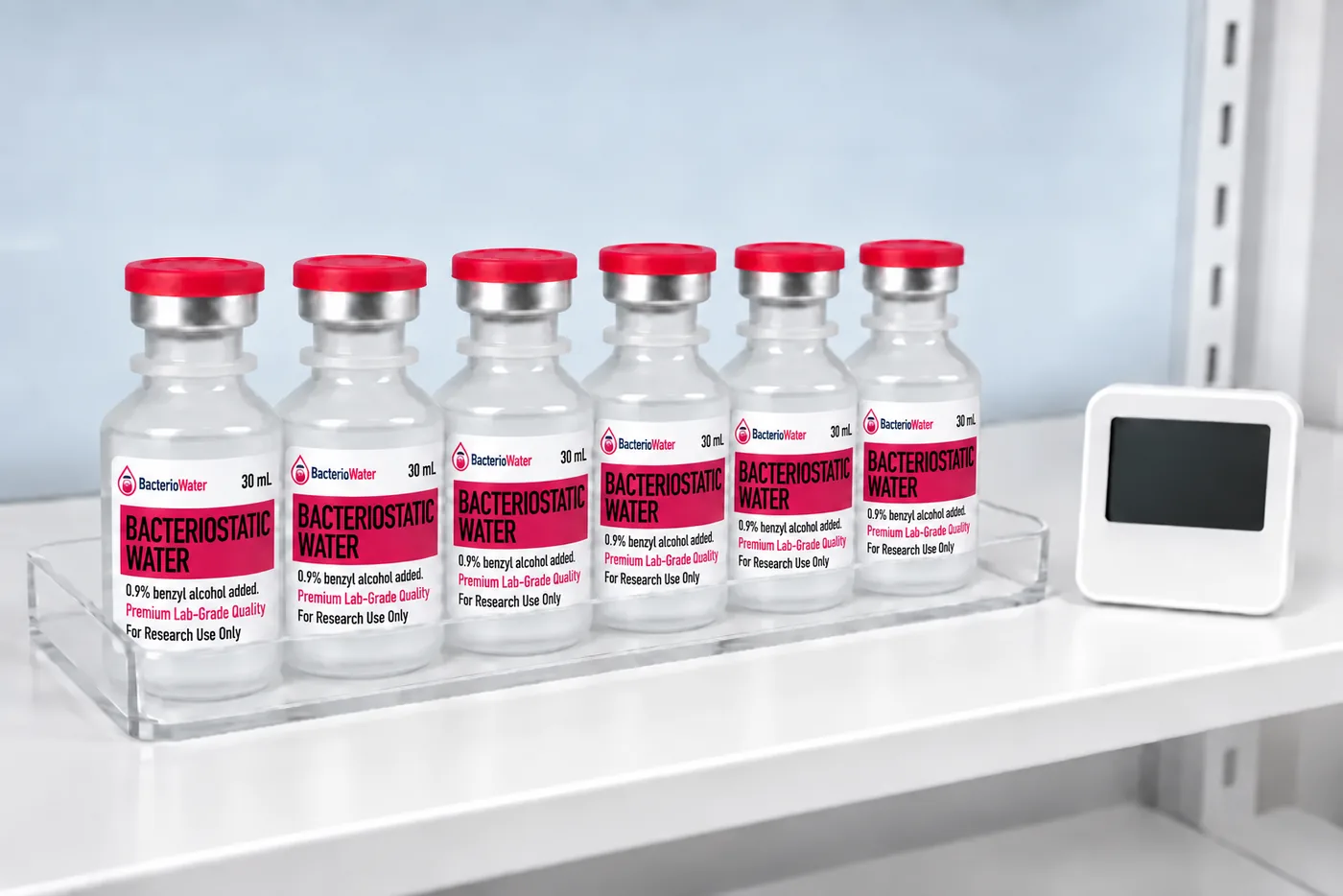
- The fill volume, such as 30 mL. Compare the liquid level across vials from the same lot. A vial that is noticeably lower than the others is worth setting aside.
- Lot code
- The field that connects the vial to a test record. Without it, no certificate can be matched to the vial.
- Expiry
- The date the manufacturer sets for the sealed vial. A missing, smudged or overprinted date is a reason to ask.
- Intended use
- A reagent sold for laboratory work should say so. Ours reads ‘For Research Use Only’.
Content matters more than print quality. A neat label can be wrong and a plain one can be complete. What a label should not have is a sticker over the original print, or a second lot code or expiry that differs from the first.
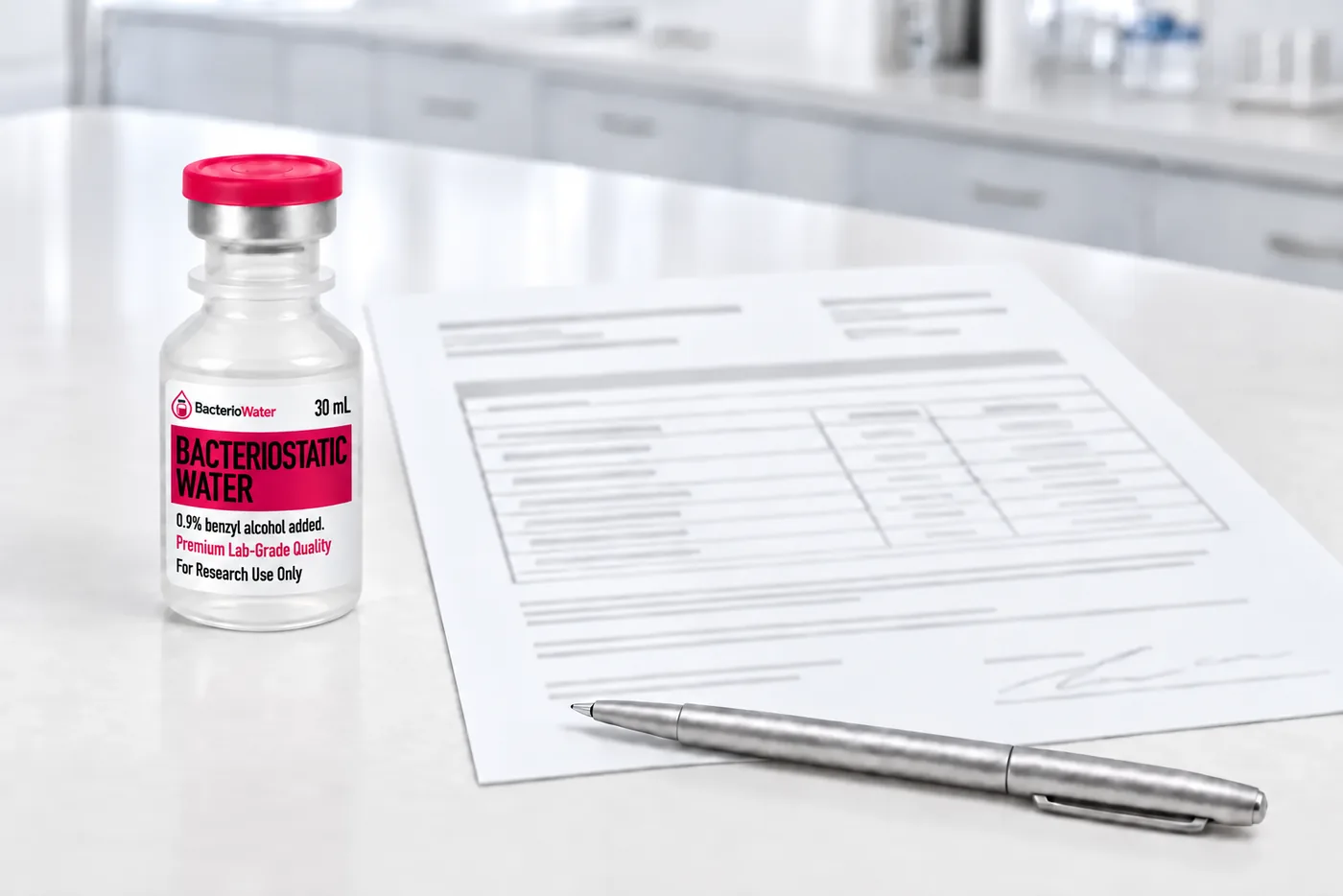
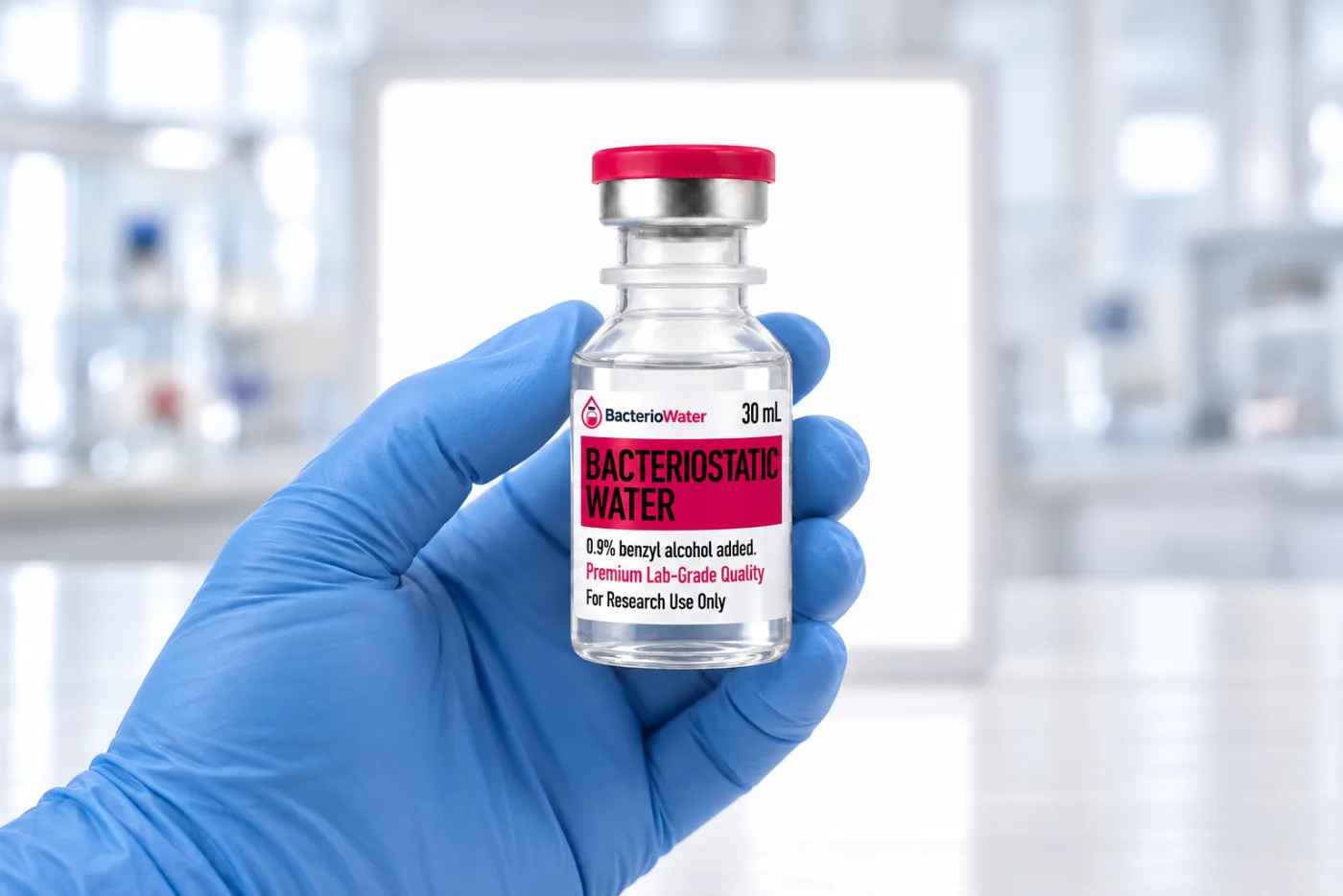
Our vials carry the product name, the volume, the preservative statement, ‘For Research Use Only’, the manufacturer’s expiry and the lot code.
Match the lot code to a published certificate
The lot code on the label should match the batch code on a certificate of analysis that the seller publishes. A certificate with no lot code, or with a code that matches none of your vials, describes some other production run.
Then confirm the certificate with the laboratory that issued it, using the certificate number and access code printed on the document. A PDF on a seller’s site shows that a document exists. Verification shows that the laboratory issued it for that lot. How to read a certificate of analysis covers the document line by line, including the verification step.
A certificate is worth less in these cases:
- The laboratory cannot find the certificate number, or names no way to check it.
- The results are a column of ‘pass’ entries with no values and no methods.
- The same certificate is shown for every lot, or for every product the seller lists.
This is the record for the lot shipping from us now:
Current shipping lot
- Product
- 30 mL Sterile Bacteriostatic Water (0.9% benzyl alcohol)
- Tested for
- Identity · Purity · Benzyl alcohol level · Microbial DNA · Sterility · Endotoxins · pH
- Tested by
- Freedom Diagnostics and Chromate, independent
- Reported
- September 4, 2026
- Status
- Currently shipping on all orders
The lot code on your vial label should match the code above.
Each certificate for lot EB61901 can be checked with the laboratory that issued it, Chromate or Freedom Diagnostics. The numbers and codes are printed on the documents on our Lab Testing & COA page. If the code on a vial from us does not match a published lot, send the code and your order number to shipping@bacteriowater.com and we confirm that lot’s status.
Inspect the seal and the stopper
A sealed vial has a rubber stopper held in place by an aluminium crimp, with a flip-off cap over it. On a vial that has not been opened:
- The flip-off cap is present and has not been lifted and pressed back.
- The crimp is tight and unbroken all the way round.
- When the cap first comes off, the stopper shows no puncture mark. A mark on a vial that should be new means it has been entered.
- There is no liquid, residue or dried deposit around the stopper or the crimp.
- The container is not cracked, warped or leaking.
The arrival check for a whole shipment, from the carton down, is in bacteriostatic water shipping. The checks here apply to any single vial, including one taken from stock months later.
Look at the liquid
Bac water should be a clear, colourless liquid with nothing floating in it or settled at the bottom. The certificates for each of our lots record the appearance. For lot EB61901 it is ‘clear liquid’.
How to inspect a vial
USP <790>, the compendial chapter on visible particles in injectable drug products, sets out a manual method. It works for a reagent vial as well:
- Use bright, even light. The chapter specifies 2,000 to 3,750 lux at the point of inspection, which is brighter than most bench lighting.
- Gently swirl or invert the vial without creating air bubbles.
- Hold it against a white background for about five seconds, then against a black background for about five seconds. Dark particles show against white. Light particles and haze show against black.
- Look with the unaided eye. The method uses no magnification.
Our vial body is a semi-translucent plastic rather than clear glass, so less detail comes through the wall. USP <790> recommends more light for containers that are not clear glass. Inspect in the brightest even light you have, and compare the vial with others from the same lot.
Two things can look like haze and are not. Fine air bubbles from handling rise and clear when the vial is left to stand. Condensation forms on the outside of a cold vial brought into a warm room; wipe it dry and look again.
If bac water looks cloudy
Cloudiness, haze, floating or settled particles, fibres or a tint all mean the vial is not as it was released. Possible causes include:
- Microbial growth after a contamination event. The preservative suppresses growth. It does not undo contamination.
- Particles from the container or closure, such as fragments of stopper cut away by a needle, which is known as coring.
- Ice, or damage left by freezing. The label excludes freezing for this reason.
- A solution that was not made or filled to its specification.
A visual check cannot tell these causes apart, and none of them can be reversed. Set the vial aside. When to discard a vial is covered in storage and handling.
What to do with a suspect vial
- Stop. Do not open the vial, or do not enter it again if it is already open.
- Set it apart from other stock and mark it, so that nobody takes it by mistake.
- Record the lot code, the expiry, the date received, the order number and what you saw.
- Photograph the vial, the label and, if you still have them, the carton and the packing.
- Check the other vials from the same lot and the same shipment, and note whether they look the same.
- Contact the supplier with the lot code, the order number and the photos. Ask for the lot’s certificate if it is not published.
- Dispose of the vial under your institution’s waste procedures once the supplier has what it needs.
For an order from us, email shipping@bacteriowater.com with those details. We review each case under our shipping & returns policy. We do not accept physical returns, so keep the vial and its packaging until we confirm we have what we need.
Checklist for a vial in hand
- The label names the product as bacteriostatic water and states benzyl alcohol 0.9%, the volume, the lot code and the expiry.
- Nothing is printed or stuck over the original label.
- The lot code matches a certificate the seller publishes.
- The certificate can be verified with the laboratory that issued it, and it reports values with methods, not only ‘pass’.
- The cap and crimp are intact, and the stopper is unmarked when it is first exposed.
- The fill level matches other vials from the same lot.
- In bright light, against white and black backgrounds, the liquid is clear and colourless with no particles.
- Any vial that fails a check is set aside, recorded and reported to the supplier.
Every vial we ship carries the lot code of the current tested lot, and that lot’s certificates are published before it ships. The 30 mL bac water vial is sold in packs of 1 to 200 in the shop.
For laboratory research use only. Not for human or veterinary use. Nothing in this article is a dosing, protocol, or medical instruction. Read the full RUO disclaimer.
References
USP <790> Visible Particulates in Injections
The manual inspection method described above: 2,000 to 3,750 lux, white and black backgrounds, about five seconds each, and more light for containers that are not clear glass.
USP <1790> Visual Inspection of Injections
General guidance on visual inspection, including products and containers that are difficult to inspect.
USP <71> Sterility Tests
The compendial sterility test. A clear vial is not a substitute for it.
USP <85> Bacterial Endotoxins Test
How endotoxin is measured and reported in EU/mL. Endotoxin cannot be seen in a vial.
Certificates of analysis, lot EB61901
The appearance, identity, benzyl alcohol content, pH, sterility, microbial and endotoxin results quoted above.
Questions this raises
What does it mean if bac water looks cloudy?
Bac water should be a clear, colourless liquid. Cloudiness means something is in the vial that should not be there: particles, microbial growth, or damage from freezing. A visual check cannot tell which. Set the vial aside, record the lot code, and contact the supplier. A cloudy vial cannot be made good again.
How can I tell if my bac water is real?
Match the lot code on the label to a certificate of analysis the seller publishes, verify that certificate with the laboratory that issued it, check the seal, and inspect the liquid. The composition, sterility and endotoxin level cannot be confirmed by eye. Only the lot’s test record confirms them.
Does a clear vial mean the water is sterile?
No. A non-sterile vial can look clear until growth makes it cloudy, and endotoxin is never visible. Sterility and endotoxin are established by laboratory tests on the lot, such as USP <71> or a validated alternative and a USP <85> method, and reported on its certificate.
Can a lab test bac water itself?
Not in a way that replaces the lot’s certificate. Sterility, endotoxin and benzyl alcohol content need validated laboratory methods. A lab that wants its own confirmation can send sealed vials from the same lot to an independent testing laboratory. Most buyers rely on the published certificate and verify it with the issuing laboratory.