Fundamentals
Benzyl Alcohol in Bacteriostatic Water: What the 0.9% Preservative Does
Bacteriostatic water (bac water) has two ingredients: sterile water and benzyl alcohol. The water is the product. The benzyl alcohol is what makes it bacteriostatic, and it is the reason one vial can be entered more than once.
This guide covers what benzyl alcohol is, why it is in the vial, what the 0.9% on the label means, how a lot is tested for it, and what can change the amount present.
Published by BacterioWater7 min read
For laboratory research use only. Not for human or veterinary use. RUO disclaimer
In short
- Benzyl alcohol is the preservative in bac water. At 0.9% there are 9 mg of it in every mL of sterile water.
- It suppresses the growth of organisms introduced when the stopper is punctured. It does not sterilise the contents.
- The USP monograph does not fix the preservative or its strength. It requires the label to name both, the content to match the label, and the preservative to pass an effectiveness test.
- A certificate should identify benzyl alcohol and measure how much is there. Lot EB61901 measured 0.921% against a 0.9% specification.
- Air slowly oxidises benzyl alcohol, and some rubbers and plastics absorb it. Both are reasons to measure the filled vial and to store it as labelled.
- Bacteriostatic water with no preservative is sterile water. Where benzyl alcohol interferes with the work, unpreserved water is the right reagent.
What benzyl alcohol is
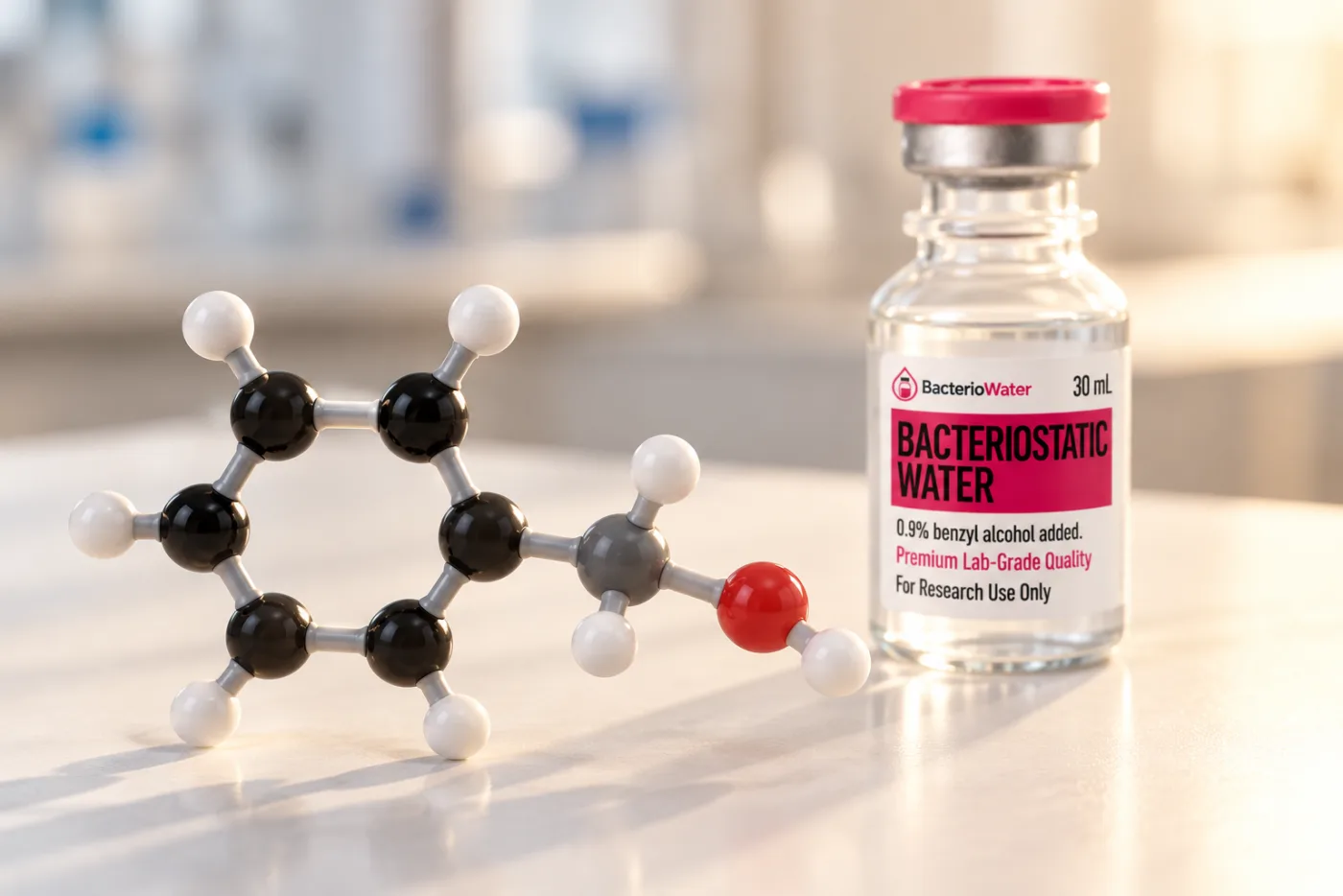
Benzyl alcohol is a simple aromatic alcohol: a benzene ring carrying one CH₂OH group. It is a clear, colourless liquid with a faint aromatic odour.
- Systematic name
- Phenylmethanol
- Formula
- C₇H₈O
- Molar mass
- 108.14 g/mol
- CAS number
- 100-51-6
- In one 30 mL vial at 0.9%
- About 270 mg
It is used widely as a preservative and as a solvent, in cosmetics, flavourings and inks as well as in drug products. In bac water it has one job: to stop organisms from multiplying in a vial that is entered more than once.
| Property | Value | What it means in a vial |
|---|---|---|
| Solubility in water | 42.9 mg/mL at 25 °C | 0.9% is 9 mg/mL, about a fifth of what water can hold, so it stays fully dissolved. |
| Boiling point | 205 °C | It does not boil off at any temperature the vial should see. |
| Vapour pressure | 0.094 mmHg at 25 °C | Low volatility. In a sealed vial, evaporation is not a route of loss. |
| UV absorption maxima | 243, 258.5 and 268 nm | It shows up in UV-detected methods, which is how the release certificate measures it. |
| Stability | Oxidises slowly to benzaldehyde and benzoic acid on exposure to air | Sealed, dark storage at the labelled temperature limits it. |
Why it is in bacteriostatic water
Sterile water stays sterile until the stopper is punctured. Each entry can carry organisms in from the stopper surface or from whatever punctures it. A preservative is added to sterile products in containers that are entered more than once to inhibit the growth of those organisms. USP <51>, the chapter on antimicrobial effectiveness testing, gives that as the reason.
Bacteriostatic means growth-inhibiting. It does not mean the preservative kills on contact or sterilises the vial. Bacteriostatic water vs sterile water explains the difference.
USP <51> also states that preservatives are not a substitute for good manufacturing practice. The water is sterile because it was sterilised and sealed. The benzyl alcohol adds a margin after the seal is broken. Aseptic technique at the stopper is still required, and storage and handling covers it.
What the 0.9% figure means
0.9% is a weight-per-volume figure: 0.9 g of benzyl alcohol in every 100 mL, or 9 mg per mL. A full 30 mL vial therefore holds about 270 mg of benzyl alcohol.
The USP monograph for Bacteriostatic Water for Injection does not name a preservative or set its strength. It defines the product as water for injection that has been sterilised and packaged, containing one or more suitable antimicrobial agents. It then asks three things of the preservative:
- The label states the name and proportion of each added agent.
- The measured content matches the label, by the method in USP <341>.
- The product passes the antimicrobial effectiveness test in USP <51>.
Benzyl alcohol at 0.9% is what our 30 mL vial is specified to. It is also what the 30 mL drug-product vial on DailyMed declares. The same drug label lists a 20 mL fill in a glass vial at 1.1% (11 mg/mL), so the strength is set by each product’s label, not by the name ‘bacteriostatic water’.
The other 0.9% in this field is sodium chloride. Normal saline is 0.9% sodium chloride, and bacteriostatic sodium chloride contains 0.9% of each. Bac water vs bacteriostatic sodium chloride sets the three side by side.
How a lot is tested for it
A certificate can do two things with the preservative. It can identify it, which confirms the substance is benzyl alcohol. It can quantify it, which measures how much is present. Identity rules out the wrong substance. Quantity rules out too little or too much. A certificate that does neither has only repeated the label.
| Test | Laboratory and date | Method | Result |
|---|---|---|---|
| Identity | Chromate, issued May 24, 2026 | RP-HPLC with UV detection | Benzyl alcohol · conforms |
| Quantity | Chromate, issued May 24, 2026 | RP-HPLC with UV detection | 0.921% against a 0.9% specification · conforms |
| Identity | Freedom Diagnostics, reported Sep 4, 2026 | LC-MS | Benzyl alcohol · confirmed |
| Purity | Freedom Diagnostics, reported Sep 4, 2026 | HPLC-UV | 99.84% |
Two laboratories, using different methods more than three months apart, both identified benzyl alcohol in this lot. The concentration figure comes from the release panel. The September retest confirmed identity and reported purity. It did not measure the concentration again.
A content result shows that the preservative is present at strength. It is not the USP <51> challenge test, in which a product is inoculated with set organisms and the counts are followed over time. The two answer different questions. How to read a certificate of analysis goes through each line of the release certificate.
What can change the amount in a vial
Air and light
Benzyl alcohol oxidises slowly to benzaldehyde and benzoic acid on exposure to air. Keeping vials sealed, in their carton and at 20 to 25 °C limits it. Storage and handling sets out the labelled conditions.
Rubber and plastic
Benzyl alcohol can move into some polymers. A 2019 study traced a steady fall in benzyl alcohol content in a prefilled syringe to its rubber stopper and tip cap, which both absorbed it and let it pass through. A 2012 study of blow-fill-seal packs found that low-density polyethylene took up most of the benzyl alcohol over three months, while polypropylene took up far less. How much is lost depends on the material, the contact area and the time.
Plastic is still a normal container for this product. The USP monograph allows glass or plastic, and the 30 mL drug-product vial on DailyMed is a polyolefin, a copolymer of ethylene and propylene. What the studies show is that the concentration should be measured in the filled, finished container rather than read off the formulation. The certificates for our lots report results for the finished 30 mL product.
The same applies once liquid leaves the vial. Solution held in plastic tubes, tubing or reservoirs for long periods can lose some of its benzyl alcohol to the plastic. Where the preservative level matters to the work, keep stock in the original sealed vial.
Evaporation
In a sealed vial, evaporation is not a meaningful route of loss. Benzyl alcohol boils at about 205 °C and has a vapour pressure under 0.1 mmHg at room temperature.
Bac water without benzyl alcohol, and when to choose it
The monograph allows any suitable antimicrobial agent, so a bacteriostatic water could in principle use a different preservative. Its label would have to name it. Remove the preservative altogether and the product is sterile water, packaged for a single entry.
Benzyl alcohol is an organic solvent and it absorbs UV, so in some methods it is an interfering substance. In a UV-detected HPLC run it appears as its own peak. The monograph itself carries a note to consider whether the preservative is compatible with the material being dissolved. Where benzyl alcohol is the problem, unpreserved sterile water is the correct reagent, with single-entry handling. Bacteriostatic water vs sterile water covers the trade-off.
We supply one formulation: sterile water with 0.9% benzyl alcohol in a 30 mL vial, with the certificates for each lot published on the Lab Testing & COA page.
For laboratory research use only. Not for human or veterinary use. Nothing in this article is a dosing, protocol, or medical instruction. Read the full RUO disclaimer.
References
PubChem CID 244 — benzyl alcohol
Water solubility, boiling point, vapour pressure, UV absorption maxima, and slow oxidation to benzaldehyde and benzoic acid.
USP monograph — Bacteriostatic Water for Injection
Definition, the labelling and content requirements for the antimicrobial agent (USP <341>), the effectiveness requirement (USP <51>), and glass or plastic containers.
DailyMed — Bacteriostatic Water, Hospira (label revised 08/2019)
Benzyl alcohol at 0.9% (9 mg/mL) in the 30 mL plastic vial and 1.1% (11 mg/mL) in the 20 mL glass vial; the vial is a polyolefin copolymer of ethylene and propylene.
Benzyl alcohol bound to, and permeated through, rubber stopper and tip-cap components.
Benzyl alcohol and chlorobutanol, at 0.5–2.0 mM, lost about 70–90% into low-density polyethylene and 7–25% into polypropylene packs over three months.
Questions this raises
What does benzyl alcohol do in bac water?
It suppresses the growth of organisms introduced when the stopper is punctured, so one vial can be entered more than once. It is a preservative, not a sterilant: the water is sterile because it was sterilised and sealed, and aseptic technique at the stopper is still required.
Is there bacteriostatic water without benzyl alcohol?
The USP monograph allows any suitable antimicrobial agent, provided the label names it and its proportion. Without any preservative, the product is sterile water, which is packaged for a single entry.
Does the benzyl alcohol level change over time?
It can, slowly, in two ways: oxidation on exposure to air, and uptake into some rubbers and plastics. Storing vials sealed, in the carton and at 20 to 25 °C limits the first. The second is why the concentration is measured in the finished vial, as it is on each lot’s certificate.