Fundamentals
What Is Bacteriostatic Water?
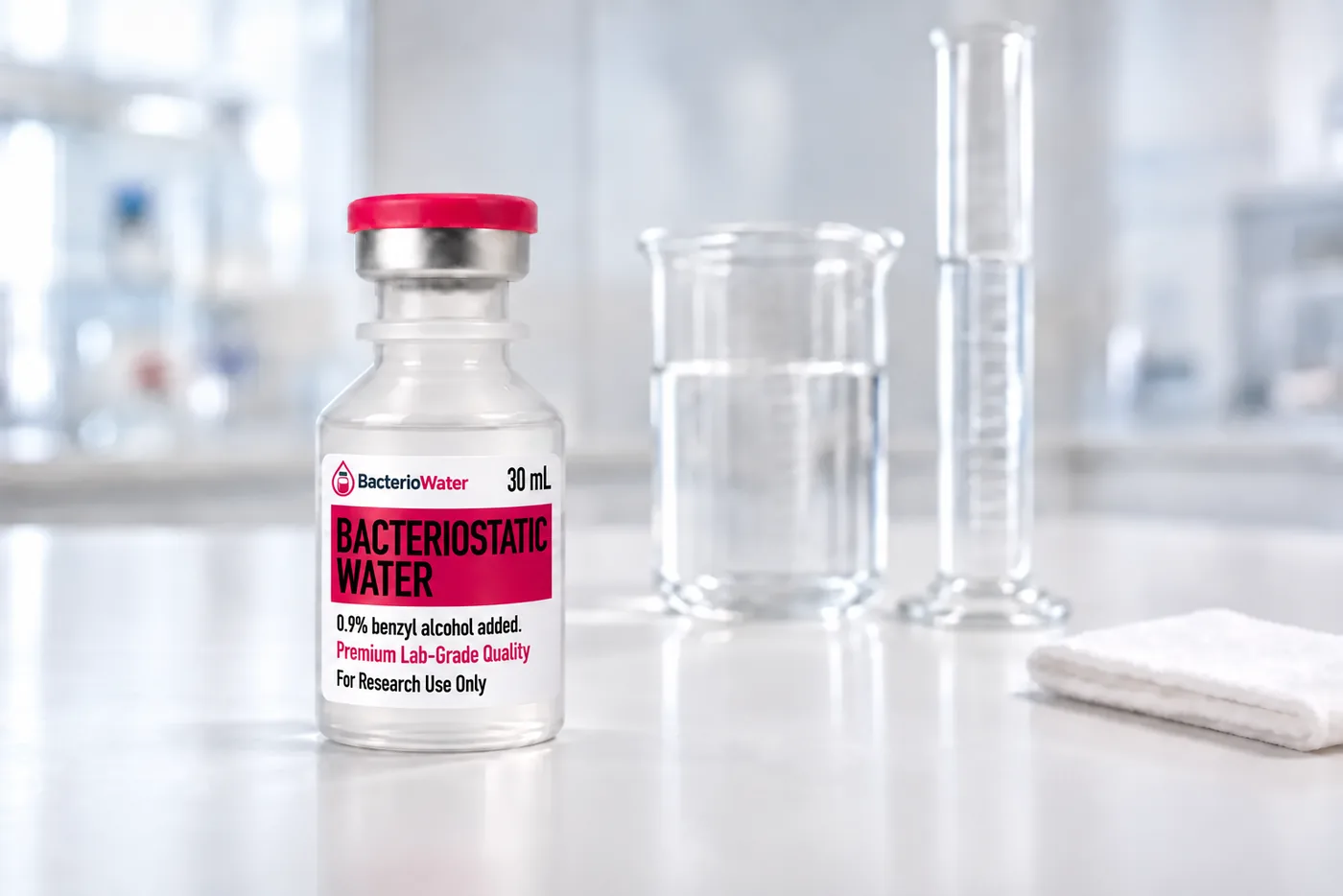
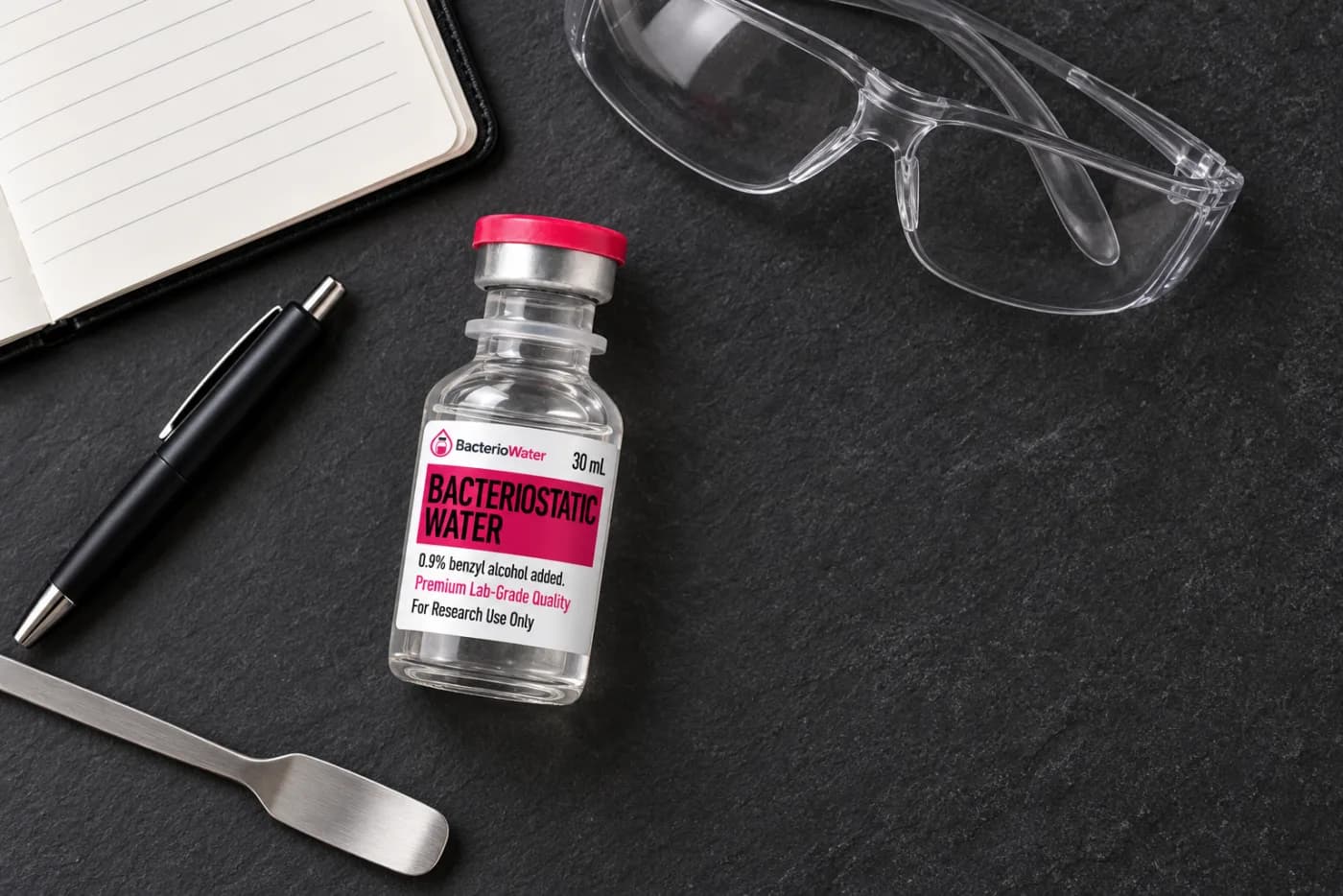
Bacteriostatic water, usually shortened to bac water, is sterile water with a preservative added. The preservative is benzyl alcohol at 0.9%, which is 9 mg in every mL. It slows the growth of bacteria that get into the vial when the stopper is punctured, so one vial can be entered more than once.
This guide explains what the name means, what laboratories use it for, how it differs from the waters it is confused with, and how to check what is in a vial. It is written for laboratory buyers. It is not guidance on using bacteriostatic water on people or animals.
Published by BacterioWater6 min read
For laboratory research use only. Not for human or veterinary use. RUO disclaimer
In short
- Bacteriostatic water is sterile water with 0.9% benzyl alcohol added as a preservative. Bac water is the same product under a shorter name.
- ‘Bacteriostatic’ means it stops bacteria from multiplying. It does not kill them, and it does not make a contaminated vial safe again.
- The preservative is what lets one vial be entered repeatedly. Plain sterile water has none and is made for a single entry.
- Two products share the name: a prescription drug product made for clinical use, and a laboratory reagent sold for research use only.
- It is stored at controlled room temperature, 20 to 25 °C. It is not refrigerated or frozen.
- The label and the certificate for the lot tell you what is in a vial. Match the lot code on one to the other.
Bacteriostatic water, defined
Bacteriostatic water has two ingredients. The first is highly purified water; in the drug product it is the grade called water for injection, which has a tight limit on endotoxin. The second is benzyl alcohol, added at 0.9% as a preservative. Nothing else is added. There is no salt and no buffer.
The finished solution is filled into vials, closed with a rubber stopper and sealed under an aluminium crimp. It is clear and colourless. The pH is mildly acidic: the drug-product label gives 5.7, within a range of 4.5 to 7.0.
The names on labels and in catalogues vary. ‘Bac water’ and ‘BAC water’ are short forms. ‘Bacteriostatic Water for Injection, USP’ is the name of the approved drug product. Laboratory suppliers sell the same formulation as a reagent, usually as ‘bacteriostatic water’ with a research-use statement on the label.
What ‘bacteriostatic’ means
A bacteriostatic agent stops bacteria from multiplying. A bactericidal agent kills them. Benzyl alcohol at 0.9% is the first kind. If a few organisms get in when the stopper is punctured, the preservative keeps them from growing into a population between one access and the next.
That is the whole job of the preservative. It does not sterilise the contents, and a vial that has been contaminated is not recovered by it. Aseptic technique still decides whether a vial stays clean. The preservative is a margin for error, not a replacement for care.
Benzyl alcohol is also an ordinary organic solvent. It absorbs ultraviolet light and shows up as a peak in HPLC runs with UV detection. Those properties matter in some assays, and they are the reason unpreserved water is sold as a separate product.
What laboratories use it for
In the laboratory, bacteriostatic water is a diluent and solvent. It is used to dissolve freeze-dried (lyophilised) materials and to prepare dilutions where the same container will be drawn from several times over days or weeks. One preserved vial can replace a row of single-use ampoules.
It is the wrong reagent when the preservative would interfere with the work. Examples are methods that integrate in the low-UV region where benzyl alcohol absorbs, cell-based work where a solvent is a variable, and any assay that is sensitive to alcohols. In those cases sterile water without a preservative is the right choice. The trade-offs are set out in bac water vs sterile water.
How it compares with similar waters
Several clear liquids are sold in similar vials. They differ in what was added and in how the container may be used.
| Product | What it contains | Preservative | Entries per container |
|---|---|---|---|
| Bacteriostatic water | Sterile water, 0.9% benzyl alcohol | Yes | More than one, with aseptic technique |
| Sterile water | Sterile water only | No | One |
| Bacteriostatic sodium chloride | Sterile water, 0.9% sodium chloride, 0.9% benzyl alcohol | Yes | More than one, with aseptic technique |
| Normal saline | Sterile water, 0.9% sodium chloride | No | One |
| Distilled or deionised water | Purified water | No | Not packaged as sterile unless the label says so |
Two posts go into the detail: bac water vs sterile water and water for injection, and bacteriostatic water vs bacteriostatic sodium chloride.
The prescription product and the lab reagent
Bacteriostatic Water for Injection, USP is an FDA-approved drug product. Its label is marked ‘Rx only’, it carries a National Drug Code, and it is dispensed for clinical use on a prescription.
Research-grade bacteriostatic water is the same formulation sold as a laboratory reagent. It is labelled for research use only and is not a substitute for the drug product. Its quality is documented by a certificate of analysis for each lot rather than by an approved drug label.
Which one a buyer needs depends on the purpose, not on price or convenience. Pharmaceutical vs research-grade bacteriostatic water explains the difference and why intended use decides it.
Shelf life and storage
Bacteriostatic water is stored at controlled room temperature, 20 to 25 °C, away from strong light and excessive heat. It is not refrigerated, and it must not freeze. Freezing can stress the stopper seal without leaving a visible sign.
An unopened vial is good until the expiry date the manufacturer prints on the label. Once the stopper has been punctured, laboratories commonly apply a 28-day in-use date, the convention USP <797> sets for preserved containers unless the manufacturer states otherwise. Storage and handling covers the conditions, the in-use date and when to discard a vial.
How to tell what is in a vial
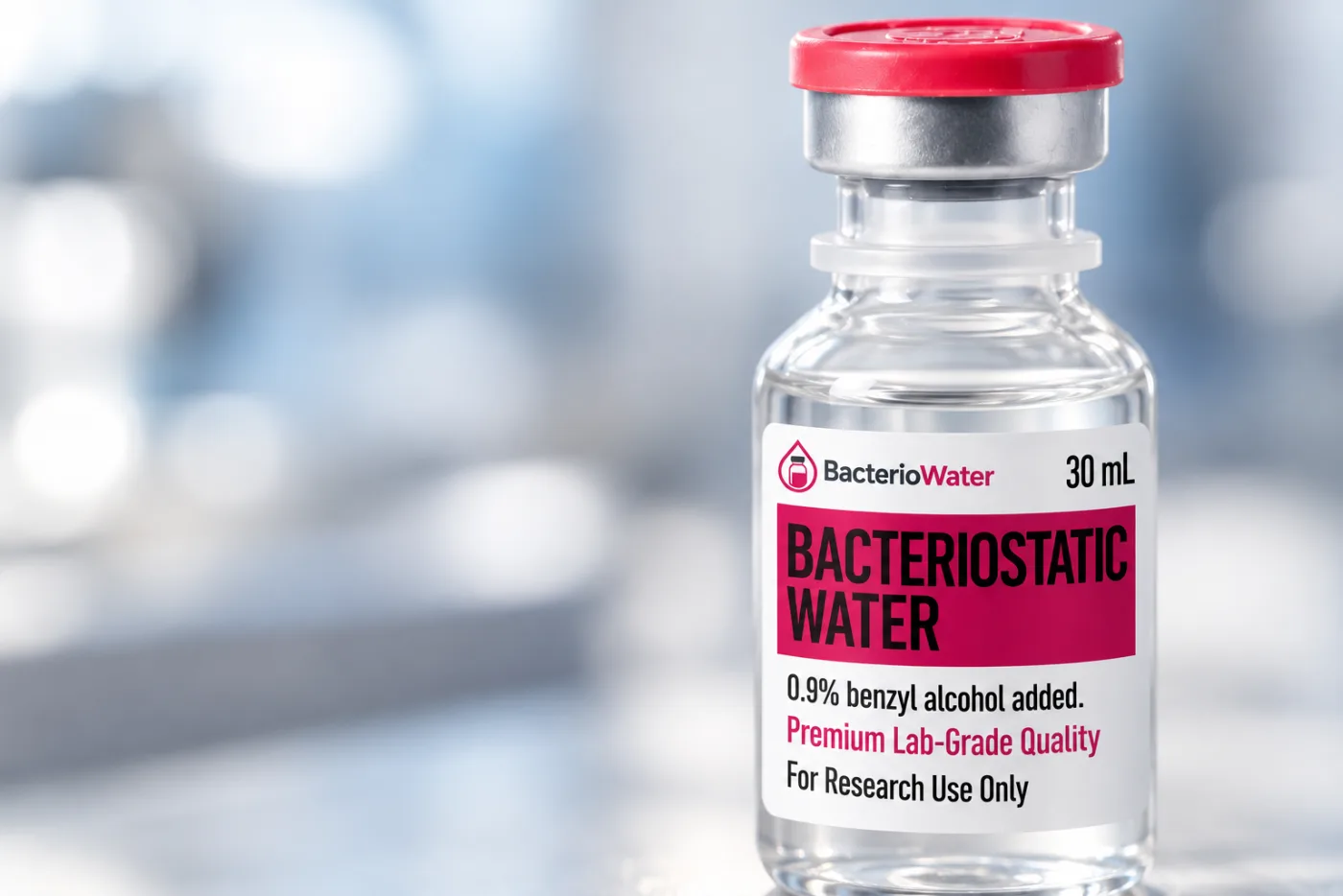
Start with the label. It should name the product, state the preservative and its concentration, and give the volume, the lot code and the expiry date. A label that leaves out the preservative concentration or the lot code tells you less than it should.
Product name. Says which product is in the vial. ‘0.9%’ on its own does not: saline and bacteriostatic sodium chloride carry the same figure.
Volume. The fill. Vials from one lot should sit at the same level.
Preservative and strength. Benzyl alcohol, 0.9%. No preservative statement means unpreserved water.
Lot code. Links the vial to its certificate of analysis. Without it, there is nothing to match.
Expiry. The manufacturer’s date for the sealed vial.
Intended use. ‘For research use only’ marks a laboratory reagent. ‘Rx only’ and an NDC mark the prescription drug product.
Then find the certificate of analysis for that lot code. A useful certificate identifies and measures the benzyl alcohol, and reports sterility, endotoxin and pH with the method used for each. The certificate for the lot we ship now, with the laboratory’s verification codes, is on our Lab Testing & COA page.
How to read a certificate of analysis goes through the document line by line. How to spot fake or cloudy bacteriostatic water covers the checks to run on a vial in your hand.
Where it is sold
The drug product is dispensed by pharmacies on a prescription. Research-grade bacteriostatic water is sold by laboratory suppliers. Where to buy bacteriostatic water compares pharmacies, marketplaces, medical-supply distributors and research suppliers, and what each one asks of a buyer.
We supply research-grade bacteriostatic water in one format: a 30 mL vial with 0.9% benzyl alcohol, in packs from one vial upwards and in wholesale quantities. The certificate for every lot is published on our Lab Testing & COA page.
For laboratory research use only. Not for human or veterinary use. Nothing in this article is a dosing, protocol, or medical instruction. Read the full RUO disclaimer.
References
DailyMed — Bacteriostatic Water for Injection, USP, Hospira (label revised 08/2019)
Composition of 0.9% (9 mg/mL) benzyl alcohol in water for injection, pH 5.7 (4.5 to 7.0), storage at 20 to 25 °C, and the ‘Rx only’ marking.
USP <797> Pharmaceutical Compounding — Sterile Preparations
The 28-day in-use date for preserved containers after first puncture, unless the manufacturer states otherwise.
PubChem CID 244 — benzyl alcohol
Identity and properties of the preservative.
Certificates of analysis, lot EB61901
The product figures in the certificate panel above.
Questions this raises
Why is it called bacteriostatic water?
Because of the preservative. Benzyl alcohol at 0.9% is bacteriostatic: it stops bacteria from multiplying without necessarily killing them. The water itself is ordinary sterile water.
Can bacteriostatic water be made in the lab?
Mixing benzyl alcohol into water does not make an equivalent product. Bacteriostatic water is filled under controlled conditions and released only after sterility, endotoxin and preservative content have been tested. A bench-made mixture has none of that evidence behind it.
Is bacteriostatic water the same as reconstitution solution?
Not necessarily. ‘Reconstitution solution’ describes a job, not a product: whatever liquid is specified for dissolving a freeze-dried material. That can be bacteriostatic water, sterile water, saline or a buffer. The label of the vial says which one it is.